

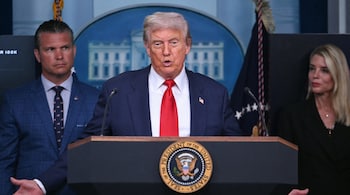
US President Donald Trump ordered the deployment of 800 National Guard troops in Washington, D.C., and federalization of the city's police department, his strongest move so far to boost military presence on US soil. The president contends the moves are necessary to combat violent crime, gangs, and homelessness, even though city officials have cited violent crime falling to a 30-year low, as per the Wall Street Journal.
Amplifying presidential authority over domestic policing
In addition to sending National Guard troops, Trump has federalized the D.C. police department on public safety grounds. The District of Columbia is unique in that it affords the president greater authorities than he would enjoy in states within the United States, and he can therefore order local National Guard forces without going through the full federalization procedure that is followed elsewhere. Critics argue this is a move towards further militarizing domestic law enforcement.
Legal and political issues regarding domestic deployment of troops
The action invites legal questions regarding the scope of the Posse Comitatus Act, which limits the deployment of military troops in civilian law enforcement except in extraordinary circumstances. Specialists caution that the nearer the National Guard moves toward conducting police functions, the greater legal and functional risks are involved. Just 100–200 of the activated soldiers will be put on duty at a time in D.C., officials indicate, and they won't be interacting directly with civilians, but doing deterrence and logistics support.
Part of a larger trend under Trump
It's not the first time that Trump has deployed military assets in domestic settings. In recent months, he has sent troops to Los Angeles during immigration enforcement demonstrations, sent active-duty and National Guard forces to the US-Mexico border, and made other military bases available for holding immigrants. In some cases, those initial deployments meant to be temporary have been extended over months.
A history of federal military presence in D.C.
Presidents have preceded and sent in troops into Washington in times of need, such as Lyndon Johnson calling upon the Insurrection Act in 1968 after Martin Luther King Jr.'s assassination. Trump's move, though, lacks such a high-level crisis scenario, which is something critics feel is an expansion of presidential authority and ultimately a precursor to future domestic military intervention.
Unclear duration and future implications
The Trump administration has not informed the National Guard for how long they will be deployed in Washington. Supporters view the deployment as a law-and-order move, whereas opponents warn that it risks obscuring the legal line between military and civilian operations. Experts view the long-term question as not merely the presence of troops in the capital, but also as whether the normalization of such deployments will become a political vehicle.
Discover the latest Business News, Sensex, and Nifty updates. Obtain Personal Finance insights, tax queries, and expert opinions on Moneycontrol or download the Moneycontrol App to stay updated!





