

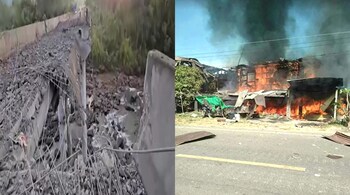
Fighting along the Thailand–Cambodia border continued on Saturday morning, despite US President Donald Trump declaring hours earlier that he had brokered a ceasefire between the two neighbours. Writing on Truth Social on Friday, Trump said he had spoken to Thai Prime Minister Anutin Charnvirakul and Cambodian Prime Minister Hun Manet, adding that both leaders had agreed to “cease all shooting effective this evening” and return to a peace agreement finalised in October.
Events on the ground quickly contradicted that claim. Thailand’s foreign ministry publicly rejected the assertion that a ceasefire had been agreed, while Prime Minister Anutin said any halt in fighting would depend on Cambodia first ending its attacks. Cambodian authorities also stopped short of confirming a truce, with the defence ministry instead accusing Thai jets of carrying out airstrikes on Saturday morning. Cambodian media reported Trump’s announcement but offered no details, even as clashes continued at several border points.
The episode has once again underlined the fragility of the July ceasefire Trump had earlier portrayed as a diplomatic success, and explains why renewed violence in December surprised few observers.
What sparked the latest escalation
The current round of fighting was triggered on December 7, when two Thai soldiers were wounded in a disputed border zone. Thailand said its engineering unit, which was constructing an access road, came under fire from Cambodian troops. The incident collapsed the already tenuous July ceasefire and reignited hostilities across multiple sections of the frontier.
Within days, artillery shelling, rocket fire and airstrikes were reported along the border. Villages in affected areas were evacuated for the second time in five months, displacing hundreds of thousands of civilians on both sides.
Roughly two dozen people have been officially reported killed so far. Thailand has acknowledged the deaths of 11 of its soldiers and claims Cambodian military losses are significantly higher. Cambodia has not released military casualty figures but says at least 11 civilians have been killed and dozens wounded.
Why the July ceasefire was bound to fail
The ceasefire announced in July ended five days of intense fighting, described by regional analysts as the worst clashes between Thailand and Cambodia in more than a decade. While Malaysia formally brokered the truce, it was pushed through under heavy pressure from Washington.
At the time, both countries faced looming deadlines to secure reduced tariff rates on key exports to the United States. Trump threatened to withhold trade benefits unless hostilities ceased. Under that pressure, the two sides agreed to halt fighting, with the arrangement later formalised in October at a regional meeting in Malaysia attended by Trump.
However, the agreement masked rather than resolved deep mistrust. Thailand was uneasy about internationalising what it considers a bilateral border issue and accepted mediation largely due to economic pressure. Cambodia, with a weaker military, favoured external involvement, believing it was disadvantaged in direct talks with Bangkok. As a result, the ceasefire depended more on external leverage than genuine reconciliation.
A border dispute rooted in history
The Thailand–Cambodia land border stretches over 817 kilometres and has been contested for more than a century. Much of the dispute traces back to colonial-era maps drawn by France in 1907, when Cambodia was under French rule. Those maps left ambiguities that both sides have interpreted to their advantage ever since.
Although many disputed areas are small and sparsely populated, they carry strong symbolic importance. Both governments frame the conflict as a defence of national sovereignty, making compromise politically risky.
Tensions escalated sharply in 2025. In May, clashes that killed a Cambodian soldier triggered nationalist backlash in both countries. Thailand imposed strict border controls, while Cambodia retaliated by banning Thai films and restricting imports of Thai goods.
Trust erodes further
Since July, relations have deteriorated further. Thailand has accused Cambodia of laying new landmines in contested areas, alleging that at least seven Thai soldiers have lost limbs. Thai authorities say they have presented evidence of these violations, describing them as proof of Cambodian bad faith.
Cambodia denies the allegations but has continued to engage Thai forces. Thailand, in turn, has refused to release 18 Cambodian soldiers captured during the July fighting.
The Thai military now insists that any ceasefire is meaningless unless Cambodia withdraws its forces and ends the use of landmines — conditions Phnom Penh has not publicly accepted.
Domestic politics harden positions
Domestic political pressures have also played a role. Prime Minister Anutin leads a fragile political arrangement and dissolved Parliament on Friday, setting the stage for early elections next year. Amid the uncertainty, he has effectively given the military broad latitude to handle the border crisis.
Thai commanders say their goal is to inflict enough damage to prevent future threats to border communities and to seize strategic hilltop positions that could offer an advantage in future clashes.
In Cambodia, Prime Minister Hun Manet governs under the shadow of his father, former leader Hun Sen. Hun Sen’s decision earlier this year to leak a confidential phone call with Thailand’s then prime minister inflamed tensions in Bangkok. Many in Thailand now believe Cambodia has interfered in their domestic politics, further reducing appetite for compromise.
Why Trump’s latest effort fell short
Trump’s latest ceasefire claim followed late-night phone calls with both leaders. Thai officials later clarified that Anutin had outlined Thailand’s position rather than agreeing to an unconditional halt. Cambodia thanked Trump and Malaysia’s prime minister for their efforts but avoided mentioning any ceasefire.
On the ground, Thailand has continued airstrikes on what it says are military targets, while Cambodia has fired thousands of BM-21 rockets. These weapons are notoriously inaccurate and have landed in civilian areas despite evacuations, fuelling public anger.
For now, Thailand says diplomacy must wait. Cambodia, Bangkok insists, must first prove its sincerity. Until the underlying mistrust is addressed, the Thailand–Cambodia border conflict appears far from over.
Discover the latest Business News, Sensex, and Nifty updates. Obtain Personal Finance insights, tax queries, and expert opinions on Moneycontrol or download the Moneycontrol App to stay updated!





