

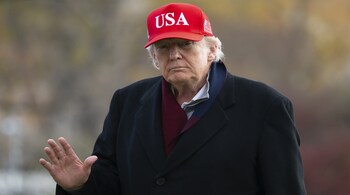
US President Donald Trump has committed to using the “influence of the presidency to bring an immediate halt” to the two-year-old war in Sudan, which the United Nations High Commissioner for Refugees estimates has displaced nearly 12 million people.
The announcement comes amid cautious optimism that Trump’s intervention could help curb the fighting, though experts warn that a long-term resolution will remain challenging. Trump, who has long presented himself as a peacemaker, initially said last week that ending the conflict “was not on (his) charts.” However, after a personal request from Saudi Crown Prince Mohammad bin Salman, he decided to engage.
“I thought it was just something that was crazy and out of control. But I just see how important that is to you and to a lot of your friends in the room, Sudan, and we’re going to start working on Sudan,” Trump said at an event alongside the Saudi leader in Washington, DC, last Wednesday.
Background of the Sudan conflict
The war pits the Sudanese Armed Forces (SAF) against the paramilitary Rapid Support Forces (RSF) and has claimed tens of thousands of lives while sparking the world’s largest humanitarian crisis. Both sides have been accused of war crimes; the Biden administration has declared that the RSF committed genocide.
The US has long worked alongside Saudi Arabia, the UAE, and Egypt as part of the “Quad” to broker peace and pave the way for democratic transition in Sudan. Trump’s administration has tasked Special Envoy Massad Boulos, an ally and Tiffany Trump’s father-in-law, to lead these efforts. Until recently, the White House had avoided direct involvement, but Trump’s personal commitment has introduced new hope.
“I think there’s a whole bunch of very needed and necessary short-term objectives that Trump can help to bring about,” said Cameron Hudson, an Africa analyst and former director for African Affairs on the National Security Council. “There’s no question, and I think he’s uniquely positioned to do it.”
Despite this optimism, a clear strategy remains absent. Sudan’s top general rejected the latest ceasefire proposal over the weekend and accused mediators of bias. “There is no sense that there’s a shift in Washington. There’s no sense that now there’s going to be a strategy,” said Kholood Khair, director of the Khartoum-based think tank Confluence Advisory, to CNN. “It’s incredibly unlikely that a truce will be reached before year-end.”
External pressures complicate peace
The conflict has been exacerbated by external support. The UAE, in particular, has faced accusations, including from US lawmakers and a UN panel, of supplying weapons to the RSF — allegations the country denies.
“Sudan has become, really, the theater of war for a lot of the US allies in the region,” Khair said. Questions remain over whether Trump is willing to pressure allies like the UAE, given strategic interests. Khair pointed out that the US values relations with Abu Dhabi, especially regarding Israel, as the UAE is a signatory of the Abraham Accords — a cornerstone of Trump’s foreign policy.
The Trump family also maintains business ties with the UAE. Forbes reported last month that the Trump Organization earns millions through licensing agreements and cryptocurrency deals with government-backed entities in the country.
While public pressure on the UAE has been limited, Secretary of State Marco Rubio recently said, “something needs to be done to cut off the weapons and the support the RSF is getting.” Rubio added that “at the highest levels of our government, that case is being made and that pressure is being applied to the relevant parties,” having spoken twice with his Emirati counterpart in November.
Trump’s role and limitations
Experts suggest Trump may have greater influence over outside actors than the warring Sudanese factions. “Trump is made for that moment,” said Hudson. “He’s made for the moment of striking an elite deal among big men. What he’s not made for is rolling up his sleeves and getting involved in the nitty-gritty of Sudanese politics.”
Jeffrey Feltman, former US special envoy for the Horn of Africa, told CNN that Trump’s comments were “promising” and “encouraging.” “I’m persuaded that the Quad countries will only take Sudan seriously… if they believe the President finds this important,” he added.
However, experts warn that even a ceasefire may not end the humanitarian suffering. Manal Taha, a Sudanese security and peace process expert, told CNN that “a ceasefire between the two warring generals is not going to stop the war and the suffering on the ground.” The conflict has deep ethnic and tribal dimensions, and decades of generational trauma will need to be addressed.
A complex road ahead
While Trump’s pledge marks a notable shift in US involvement, achieving lasting peace will be challenging. Diplomatic efforts continue to stall, and the Sudanese generals remain defiant. Nevertheless, the president’s engagement, particularly with regional powers, could provide the leverage necessary to reduce violence in the short term.
For millions affected across Sudan, the situation remains perilous, and experts stress that enduring resolution will require more than presidential influence — it will demand a careful balance of diplomacy, regional cooperation, and addressing the deep-rooted causes of the conflict.
Discover the latest Business News, Sensex, and Nifty updates. Obtain Personal Finance insights, tax queries, and expert opinions on Moneycontrol or download the Moneycontrol App to stay updated!





