

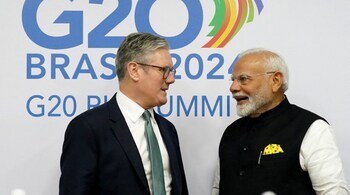
British Prime Minister Keir Starmer’s maiden official visit to India in October marks a pivotal moment in New Delhi–London relations. The visit comes at a time when global trade politics are in flux, with US President Donald Trump’s tariff push unsettling economies worldwide. For India and the UK, the meeting offers a chance to build on recent breakthroughs, particularly the landmark Free Trade Agreement (FTA) signed in July, and to open new areas of cooperation. From trade and technology to tackling the long-pending issue of economic fugitives, the agenda is expected to be wide-ranging. Starmer’s presence in India signals that both nations are ready to deepen ties across economic, security and people-to-people domains.
Trade and FTA: Building on momentum
The India–UK Comprehensive Economic and Trade Agreement (CETA), signed in July after three years of negotiations, represents a landmark in India’s trade diplomacy. It is India’s most significant deal with a Western nation and the UK’s biggest trade agreement since leaving the European Union.
The deal aims to double bilateral trade to $120 billion by 2030, with India benefiting from duty-free access on 99 per cent of tariff lines. Labour-intensive sectors such as textiles, footwear, gems and jewellery, chemicals and auto components are set to gain. Starmer’s visit will provide an opportunity to review the progress of ratification and ensure the agreement comes into effect in 2026.
Tackling the extradition challenge
Alongside trade, extradition of high-profile economic fugitives remains a priority for India. The UK continues to shelter businessmen such as Vijay Mallya, Nirav Modi and Sanjay Bhandari. In a significant step, UK prosecutors recently toured Tihar Jail to assess conditions before deciding on pending extradition requests. This inspection signals movement in cases that have long frustrated Indian authorities. Starmer’s talks with Prime Minister Narendra Modi are likely to include this sensitive issue, with New Delhi expected to press for faster legal cooperation. A breakthrough could remove a major irritant in bilateral relations.
Technology partnerships on the rise
Starmer is also scheduled to attend the India–UK Tech Summit in Mumbai, where technology and innovation will take centre stage. According to Politico, both governments are working towards closer cooperation in artificial intelligence, digital infrastructure and emerging technologies. This builds on the “Roadmap 2030” launched in 2021 that identified science, innovation and technology as pillars of the partnership. Stronger tech ties are expected to create new opportunities for start-ups and research collaboration, while enhancing digital trade.
Navigating global trade pressures
The backdrop to Starmer’s India visit is the global disruption caused by US tariffs. India has faced additional levies on oil imports, while the UK has only managed a non-binding deal with Washington on tariff reduction. Both India and the UK share an interest in diversifying trade ties and cushioning their economies against American unpredictability. Closer coordination between New Delhi and London will help both countries navigate this uncertain global environment while strengthening their bilateral agenda.
Starmer’s trip is more than a courtesy call. It is a chance to consolidate gains from the FTA, address long-standing legal hurdles and expand collaboration in cutting-edge technologies. If the talks deliver, India and the UK could move towards a more comprehensive strategic partnership that balances economic, security and global challenges alike.
Discover the latest Business News, Sensex, and Nifty updates. Obtain Personal Finance insights, tax queries, and expert opinions on Moneycontrol or download the Moneycontrol App to stay updated!





