

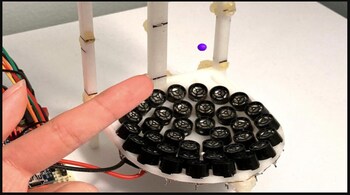


In a striking new experiment, researchers at New York University have created a previously unseen type of time crystal, one that can be suspended in mid-air and display behaviour that seems to run counter to the rules we learn in basic physics. The findings were published in Physical Review Letters, drawing attention from scientists interested in unusual states of matter.
Despite the name, time crystals are not gemstones. They are systems of particles that move in a steady, repeating rhythm over time, even when they are in their lowest energy state. That feature sets them apart from ordinary crystals, which repeat their structure across space rather than through time. The concept was first proposed a little over a decade ago and has since been demonstrated in highly controlled quantum experiments.
What sets this latest work apart is the way the researchers built and observed the system. The NYU team used carefully tuned sound waves to lift tiny plastic beads, similar to lightweight packing beads, so they floated in air. In this acoustic field, the beads started to interact and move in a systematic, clockwork fashion. Once begun, the system continued to function in rhythm without any additional direct mechanical stimulation.
On the face of it, it seems as if the system of beads contradicts Newton’s Third Law of Motion, which says that every action is always accompanied by an equal and opposite reaction. In the system of beads, the larger beads react to sound waves in a manner that is not equal to the reaction of the smaller beads, thus providing an unequal reaction. This enables the particles to organize themselves in a periodic motion through what is called non-reciprocal interactions.
But scientists are quick to point out that no law of physics is being violated in this experiment. Instead, the experiment demonstrates how systems that respond to external forces, such as sound waves, can function in a manner different from those that function in isolated physical systems. Because the system can be changed in real time, it provides a useful model system for understanding motion, symmetry, and energy transfer in systems that are far from equilibrium, an area of physics that is still only partially understood.
By conducting this experiment, scientists have the rare chance to explore complex phenomena that exist at the crossroads of theoretical physics and potential applications.
Discover the latest Business News, Sensex, and Nifty updates. Obtain Personal Finance insights, tax queries, and expert opinions on Moneycontrol or download the Moneycontrol App to stay updated!





