

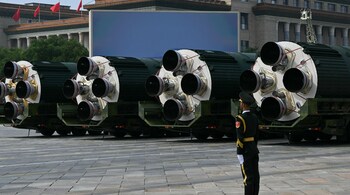
China is rapidly expanding its missile production capabilities, sparking global concern about a new arms race. A CNN investigation based on satellite images has revealed that Beijing has quietly ramped up its missile infrastructure over the past five years, transforming farmlands and villages into large military-industrial complexes.
Massive growth in missile sites
The report found that China currently has 136 locations linked to its Rocket Force (PLARF) and related defence production. Over 60 per cent of these sites have expanded significantly since 2020, suggesting a coordinated push to boost missile output.
The satellite images reveal new towers, underground bunkers, and testing facilities. Some missile parts were even found stored outdoors. Between 2020 and late 2025, the total construction area of these sites increased by nearly 2 million square metres, indicating an unprecedented military buildup.
Experts believe this surge in missile production marks one of the most significant developments in global defence capabilities in recent years.
‘A decisive step toward superpower status’
William Alberque, senior fellow at the Pacific Forum and former NATO arms-control director, told CNN, “This is a decisive step toward China’s rise to superpower status. We are witnessing a new arms race. China has already run the race and is preparing for the marathon.”
Since coming to power in 2012, President Xi Jinping has repeatedly vowed to transform the People’s Liberation Army (PLA) into a “world-class fighting force.” Within this vision, the Rocket Force (PLARF) plays a critical role as China’s main nuclear and ballistic missile wing. Xi has described it as the nation’s “strategic shield” and the “foundation of national security.”
Missiles aimed at Taiwan and US
Analysts say that China’s latest expansion is not just about building weapons but also about preparing for future conflicts. The missiles being produced could play a decisive role in China’s strategy toward Taiwan.
Decker Eveleth, an analyst at the US-based CNA think tank, said, “China plans to target Taiwan’s ports, helipads, and supply bases to block the US or its allies from sending any aid.”
This strategy aligns with China’s long-term goal of creating an “anti-access/area-denial zone” in the region, effectively keeping the US Navy and allied forces away from Taiwan’s defense perimeter.
US faces growing pressure
The United States is now under pressure to keep up with China’s pace. Its stock of advanced THAAD interceptor missiles has already been depleted by nearly 25% due to heavy military aid to Ukraine and Israel.
To counter this, Lockheed Martin has been given a $2 billion contract to increase missile production. However, the cost and time involved in manufacturing remain significant obstacles. Each THAAD interceptor costs $12.7 million (around Rs 106 crore) and takes months to build.
This imbalance has prompted fresh debates in Washington over the sustainability of America’s defence manufacturing capacity, especially as rivals like China and Russia expand theirs.
Should India take note?
For India, China’s missile buildup has direct strategic implications. The PLARF has already deployed several short- and medium-range missiles along India’s northern borders, and new production capabilities could make these deployments more frequent and sophisticated.
China’s growing cooperation with Pakistan, including joint missile and drone development, adds another layer of complexity for New Delhi. As India continues to modernise its own missile and air defence systems, experts suggest that monitoring these Chinese developments must remain a key national security priority.
India’s emphasis on indigenous projects like Agni-V, Pralay, and Akash-NG, along with joint ventures with countries like France and Israel, may help bridge the gap. However, China’s scale of investment and rapid expansion are reminders of how fast the regional balance of power is evolving.
Discover the latest Business News, Sensex, and Nifty updates. Obtain Personal Finance insights, tax queries, and expert opinions on Moneycontrol or download the Moneycontrol App to stay updated!





