

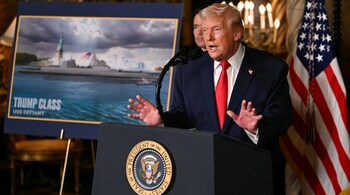
US President Donald Trump has announced plans for a new generation of American warships that will carry his name, unveiling what he described as the “Trump class” of battleships as part of a broader naval modernisation push.
Speaking from his Florida residence on Monday, Trump said the new vessels would “help maintain American military supremacy, revive the American ship-building industry, and inspire fear in America’s enemies all over the world.” He added that the ships would anchor a larger naval programme called the “Golden Fleet,” aimed at countering China and other potential adversaries.
Trump was flanked during the announcement by his Secretary of War Pete Hegseth and Secretary of State Marco Rubio.
‘100 times more powerful than any battleship ever built’
Trump framed the project as a response to what he described as the ageing state of the US fleet. “As you know, we’re desperately in need of ships. Some of them have gotten old and tired and obsolete, and we’re going to go the exact opposite direction,” he said.
Announcing the new class, Trump claimed he would personally influence the design. “The US Navy will lead the design of these ships along with me because I’m a very aesthetic person,” he said.
He repeated earlier criticisms of existing naval designs, saying, “I’m not a fan of some of the ships you do. I’m a very aesthetic person and I don’t like some of the ships you’re doing aesthetically.” At a previous event at Quantico, Trump had remarked, “They say, ‘Oh, it’s stealth.’ I say that’s not stealth. An ugly ship is not necessary in order to say you’re stealth.”
Trump said he had approved two battleships initially, with plans to build up to 25. The first vessel would be named USS Defiant. “They’ll be the fastest, the biggest, and by far, 100 times more powerful than any battleship ever built,” he claimed.
Weapons, nuclear capability and AI ambitions
According to Trump, the ships would be equipped to carry hypersonic and “extremely lethal” weapons and serve as flagships of the US Navy. They are also expected to be armed with a nuclear-armed sea-launched cruise missile, or SLCM N, currently under development.
Trump added that the ships would function as command and control platforms overseeing both crewed and uncrewed systems, with artificial intelligence driven capabilities incorporated into their design. Documents shared by the administration indicate the ships would displace between 30,000 and 40,000 tonnes.
The president stressed that construction would be domestic. He said the ships would be built using American steel and assembled by both robots and human workers.
When asked whether the new battleships were aimed at China, Trump responded, “It’s a counter to everybody. It’s not China. We get along great with China. It’s just everybody. You don’t know who comes along, but we just wanted peace through strength. Hopefully we never have to use them, but there will never be anything built like these.”
Why the timing matters
Trump’s announcement comes amid long-standing concerns about the health of America’s shipbuilding base. Defence analysts have warned of workforce shortages, fragile supply chains, ageing shipyard infrastructure and chronic delays.
A report by Politico noted that every US Navy ship currently under construction is at least a year behind schedule, with shipyards struggling to hire and retain skilled workers.
Concerns have also grown over China’s rapid naval expansion. A US Congress report has warned that Washington has fallen behind Beijing in overall fleet numbers. Research by the Center for Strategic and International Studies found that China operates 234 warships compared with the US Navy’s 219, even though the US retains advantages in cruisers and destroyers.
Skepticism and challenges ahead
Despite the bold claims, Trump’s plan faces major hurdles. There is no clear funding line for the programme in the current Pentagon budget, and defence experts question the feasibility of delivering new battleships within Trump’s proposed two-and-a-half-year timeline.
Mark Montgomery, a retired US Navy officer now with the Foundation for the Defense of Democracies, warned that the project would pose “a massive life cycle maintenance challenge.” He said, “The cost of maintaining supply chains, maintenance support and system training for a large number of small ship classes will break the navy’s operational budget for decades.”
US Representative Joe Courtney described the proposal as vague. “The proposal to bring back battleships raises many questions for Congress to scrutinise,” he said. Courtney added, “There is a reason that the US Navy stopped building battleships in 1944 and that President Ronald Reagan’s 600-ship fleet didn’t bring them back.”
Critics also argue that large surface ships are increasingly vulnerable in modern warfare, pointing to the use of drones and hypersonic missiles in recent conflicts, including Ukraine’s attacks on Russia’s Black Sea fleet.
Administration defends the vision
Despite the skepticism, Hegseth defended the plan, portraying it as a long-term investment. “For decades, for centuries, the American people will look back and thank President Trump for having the vision and the willingness to invest right now in capabilities we need,” he said.
Whether Trump’s “Trump class” warships become a transformative leap for the US Navy or an ambitious vision constrained by cost, time and technology will depend on decisions yet to be taken by Congress, the Pentagon and the shipbuilding industry itself.
Discover the latest Business News, Sensex, and Nifty updates. Obtain Personal Finance insights, tax queries, and expert opinions on Moneycontrol or download the Moneycontrol App to stay updated!





