

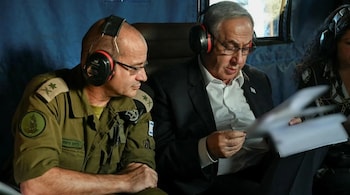
Israel’s intelligence establishment is set for a surprising change. Prime Minister Benjamin Netanyahu has chosen a senior army officer, Major General Roman Gofman, to become the next director of Mossad when current chief David Barnea completes his term in June 2026. The decision marks an unusual shift because Gofman has never worked inside the intelligence agency he is now preparing to lead.
The announcement comes as Israel continues to deal with the security fallout of the October 7, 2023 Hamas attack and the wider conflict that followed. Netanyahu selected Gofman after months of internal discussions. Since 2024, Gofman has been serving as the prime minister’s military secretary, a role that brought him into daily contact with Mossad, the Shin Bet, and the Israel Defense Forces (IDF).
Why Netanyahu chose Gofman
Gofman spent nearly three decades in the IDF, holding positions in the Armoured Corps, field brigades, and regional divisions. His background is entirely military, but Netanyahu’s office publicly endorsed him with enthusiastic praise. In a statement, the PMO described him as “an officer of great merit,” and said his work as military secretary “proved his exceptional professional capabilities.”
The statement highlighted traits that Netanyahu believes are vital for the Mossad director. He was described as having “creativity, initiative, ingenuity, deep knowledge of the enemy, complete discretion, and strict confidentiality.” These attributes, according to the PMO, justify his transition from the military into the world of intelligence leadership.
Although Mossad has occasionally been led by military figures, most chiefs have come from within its ranks. Gofman’s appointment has therefore drawn attention. Despite that, there has not been significant institutional resistance. This contrasts sharply with the public controversy surrounding Netanyahu’s appointment of Major General David Zini to head the Shin Bet earlier this year.
Gofman’s rise through the military
Roman Gofman was born in Belarus in 1976 and moved to Israel as a teenager in 1990. He enlisted in the IDF Armoured Corps at age 19. Over time, he rose from tank commander to battalion and brigade commander, eventually leading the 210th “Bashan” Regional Division in the Golan Heights.
His career has not been without controversy. During his time commanding the 210th Division, classified information was passed through a teenage social media influencer, Ori Elmakayes. The teenager was later detained for 18 months. Gofman said he believed only non-classified material had been authorised for release and stated that he did not know the teen’s age. Investigators eventually dropped charges when they concluded Elmakayes had acted with authorisation.
Gofman also became known for his outspoken criticism of Israel’s reliance on air power. In a 2018 speech before senior officers, he argued that Israel should not shy away from ground operations. “There is one problem, you’re not deploying us,” he said, warning that a pattern of avoiding ground forces was “very troubling.”
Wounded on October 7 and close to Netanyahu
When Hamas launched its attack on October 7, 2023, Gofman rushed from his command post to the Gaza border. He was badly injured while fighting militants near Sderot. Netanyahu later praised him publicly, saying, “He was wounded there, recovered, and has been doing tremendous work for Israel’s security.”
After recovering, Gofman briefly served in the Coordinator of Government Activities in the Territories (COGAT). While there, he wrote an internal paper recommending that Israel retain military control over Gaza after defeating Hamas. The IDF clarified at the time that it was his personal view, not official policy.
His appointment to Mossad now appears to reflect both ideological alignment and the trust he built with Netanyahu over the last two years. Though Gofman is not outwardly religious, he studied at the Ely Yeshiva in the West Bank, a religious Zionist institution. Critics argue this worldview matches Netanyahu’s political agenda. Haaretz columnist Uri Misgav criticised the choice, saying Gofman is “unfit to head Mossad,” and suggesting the decision is based largely on loyalty.
What Mossad inherits
Under David Barnea, Mossad has maintained an aggressive operational posture abroad. Barnea oversaw missions targeting Hezbollah leaders, covert actions linked to attacks on Iranian forces, and operations involving Iranian dissidents. He also played a role in actions connected to the 2020 assassination of Mohsen Fakhrizadeh, a key figure in Iran’s nuclear weapons programme.
Unlike the Shin Bet and military intelligence agencies, Mossad was not blamed for failures related to the October 7 attack, which focused largely on Gaza intelligence. Barnea therefore remains one of the only senior security chiefs to keep his position after the attack.
Roman Gofman will inherit an agency operating at high tempo, deeply focused on Iran and its proxies, and playing a significant role in Israel’s current regional strategy. With no prior experience inside Mossad, his transition will test both the agency’s traditions and his ability to lead the world of covert intelligence.
Discover the latest Business News, Sensex, and Nifty updates. Obtain Personal Finance insights, tax queries, and expert opinions on Moneycontrol or download the Moneycontrol App to stay updated!





