

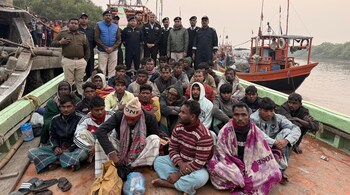
The Indian Coast Guard on December 16 intercepted two Bangladeshi fishing boats that had crossed deep into India’s Exclusive Economic Zone in the northern Bay of Bengal, once again highlighting what Indian officials see as a deliberate pattern rather than accidental incursions.
The vessels were detected by ICG Ship Anmol during routine maritime surveillance. Coast Guard personnel found the boats actively fishing inside Indian waters, with fishing gear deployed and around 500 kilograms of fish catch on board. None of the 35 crew members could produce valid documents or permits authorising them to operate within India’s maritime limits.
The boats and their crew were detained and later handed over to the Marine Police at Frazerganj in West Bengal for further legal action under the Maritime Zones of India (Regulation of Fishing by Foreign Vessels) Act, 1981.
This is not an isolated case. Over the last three months, the Indian Coast Guard has apprehended several Bangladeshi fishing vessels and detained more than a hundred crew members for violating India’s EEZ. Indian authorities say the repeated nature of these incidents weakens claims that the crossings are accidental or driven purely by livelihood concerns.
Intelligence and diplomatic sources tracking developments in Dhaka tell CNN-News18 that the issue has taken on a political colour inside Bangladesh. According to these sources, sections of Bangladeshi political groups and media have begun portraying the detentions as Indian “harassment” of poor fishermen, despite the clear violation of international maritime norms.
Officials cited by CNN-News18 say this narrative is being pushed deliberately to stoke domestic sentiment at a time when Bangladesh is grappling with economic pressure. By framing lawful Indian enforcement as hostile action, critics in New Delhi believe Dhaka is attempting to redirect internal frustration outward.
Top intelligence sources told CNN-News18 that the repeated EEZ violations fit a pattern of calculated, deniable pressure tactics. They said civilian fishing boats are increasingly being used to test maritime boundaries without risking direct military confrontation.
These sources described the approach as a form of grey zone behaviour, where civilian actors are deployed to challenge sovereignty while maintaining plausible deniability. According to them, such incursions also allow for observation of Indian Coast Guard responses and create opportunities for informal intelligence gathering.
Indian officials say the pattern raises serious questions about intent, especially as arrests are followed by political messaging in Bangladesh portraying India as aggressive. From New Delhi’s perspective, this combination of repeated violations and narrative building reflects a deliberate attempt to politicise illegal activity rather than address it.
Discover the latest Business News, Sensex, and Nifty updates. Obtain Personal Finance insights, tax queries, and expert opinions on Moneycontrol or download the Moneycontrol App to stay updated!





