

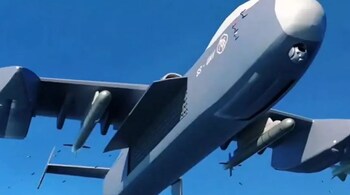
As global militaries race to dominate the skies with next-generation aerial technologies, China is preparing to unveil a game-changer—Jiu Tian, a massive unmanned aerial mothership capable of launching and coordinating over 100 drones in a single mission. Set to undergo real-world testing, this stealth-enabled, AI-powered platform isn’t just a futuristic concept—it’s a potent symbol of how Beijing is redefining warfare itself.
At a time when regional tensions are simmering and battlefield doctrines are evolving, the Jiu Tian project signals a major leap in autonomous combat systems, potentially allowing China to overwhelm enemy defences without deploying a single pilot.
Key features of Jiu Tian
Jiu Tian can launch more than 100 drones in a single mission, with real-time coordination enabled by AI. The drones could serve multiple roles – surveillance, decoys, electronic warfare, kamikaze strikes and precision targeting.
Weighing 16 tonnes at takeoff and featuring a 25-metre wingspan, it can carry a payload of up to six tonnes—including precision-guided weapons, reconnaissance gear, and over 100 smaller drones—covering distances of up to 7,000 kilometres (4,350 miles).
The mothership itself is unmanned, meaning lower risk to personnel and higher endurance. It can function in high-risk zones, deep behind enemy lines or contested airspace, without putting human pilots in harm’s way.
Designed with low radar cross-section, Jiu Tian can avoid early detection. It is reportedly equipped with radar-absorbing materials and a low-emission engine system for stealth operations.
It is capable of flying at very high altitudes - 15,000 metres (50,000 feet), beyond the reach of many short-range defense systems, and staying airborne for extended periods, allowing for surveillance and delayed-release missions.
The drones launched can communicate in real time with each other and the mothership using AI-powered network systems, executing complex, coordinated maneuvers autonomously. Think of it as a flying hive with a robotic queen managing the swarm.
A video recently released on Chinese state media showcases the Jiu Tian system ejecting dozens of small drones simultaneously from both sides of the fuselage.
Should we be worried?
While the new UAV system is yet to deployed, its use in future will force the adversaries to rethink the defence planning. A long-endurance mothership designed to deploy kamikaze drone swarms could be used to disrupt radar networks, overwhelm air defenses, and sustain continuous strike operations—all without putting manned aircraft at risk.
Jiu Tian is designed to compete with advanced US UAV platforms such as the RQ-4 Global Hawk and MQ-9 Reaper. Although these American drones excel in strategic surveillance and multirole operations, neither currently has the capability to launch coordinated drone swarms.
Even from India’s perspective, systems like Akash, Spyder, or even the S-400 may be effective against large targets, but swarms require different countermeasures, like directed energy weapons, electromagnetic pulse (EMP) tech, or dedicated anti-drone jammers - areas where we still lag behind China.
Discover the latest Business News, Sensex, and Nifty updates. Obtain Personal Finance insights, tax queries, and expert opinions on Moneycontrol or download the Moneycontrol App to stay updated!





