

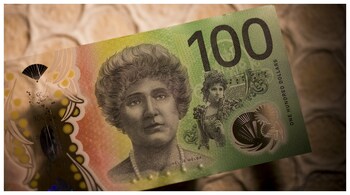
The Australian dollar is nearing its strongest level in three years propelled by the central bank’s hawkishness and as the threat of a joint US-Japan yen defense weighs on the greenback.
The Aussie has gained nearly 4% in 2026 to around 69 US cents to be among the top three Group-of-10 currency performers so far this year. It may climb to 70 US cents by end-March, a level last seen in early 2023, according to strategists from Commonwealth Bank of Australia and Westpac Banking Corp.
It is benefiting from Australian bonds offering the developed world’s highest yields amid bets on a local interest-rate hike next month. Benchmark 10-year yields hit a 26-month high Tuesday, pushing the US-Australia spread to its widest in three years and supporting the Aussie.
This yield gap protects the Aussie from global jitters, including US trade disputes and the risk of yen intervention that are weighing on the greenback. Such resilience supports the bullish Aussie outlook, with Societe Generale SA Chief Currency Strategist Kit Juckes forecasting the currency to advance to 70 US cents by mid-year.
“It could be seen as a higher-yielding safe haven at a time when the dollar isn’t trusted, the euro is strong but brittle, while the yen is cheap but scary,” said Juckes, adding that the Aussie is “my favorite currency for now.”
The Aussie rallied by the most since August on Thursday after data showed the economy added more jobs than expected in December. Money markets are now pricing a 60% chance of a rate hike in February, up from less than one-third prior to the jobs print.
Traders are shifting focus to inflation data this week to cement currency wagers ahead of the Reserve Bank of Australia’s policy decision on Feb. 3. A Bloomberg survey shows core consumer inflation rose 3.3% last month, overshooting the RBA’s 2%-3% target band.
Along with high yields, investors are also drawn to Aussie bonds due to their top credit rating at a time when the “de-dollarization” theme gains momentum due to concerns over another US government shutdown.
“Weak sentiment toward the US dollar, the prospect of RBA rate hikes and high metals prices explain the resilience of Aussie despite renewed geopolitical and trade tensions,” said Carol Kong, a strategist at CBA in Sydney.
“We also see scope for a February RBA rate hike to be more fully priced, which can give Aussie dollar another leg up,” she said.
Widening rate differentials have helped decouple the Aussie from gyrations in the stock market. The Aussie’s 30-day inverse correlation with a gauge of stock market volatility dropped to its lowest since October last week, according to data compiled by Bloomberg.
The Aussie “should be the ‘Teflon’ currency when thinking about a sound balance of payments backdrop, prudent monetary policy and a prettier fiscal picture than many other currencies,” said Paul Mackel, head of FX research at HSBC Holdings Plc in Hong Kong.
The currency is likely trade at 69 cents by mid-year, and “the risks are skewed to the upside,” he said.
Beyond macro fundamentals, a weekly fibonacci retracement analysis, used by traders to identify potential support and resistance levels, suggests there are few barriers for the Aussie to climb toward 70 US cents. It also shows losses may be limited around 67 cents.
The options market early Tuesday assigned an over 70% chance it’ll touch 70 US cents by end-March, according to data compiled by Bloomberg.
“Aussie-dollar is in excellent shape,” said Richard Franulovich, head of FX strategy at Westpac. “In a world without shocks, no data or news, its natural bias will be to drift higher.”
Discover the latest Business News, Sensex, and Nifty updates. Obtain Personal Finance insights, tax queries, and expert opinions on Moneycontrol or download the Moneycontrol App to stay updated!





