

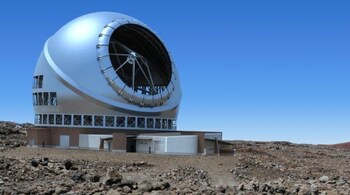
India and Japan are joining forces to build a giant telescope. The Thirty Metre Telescope aims to study distant planets. It will search for signs of extraterrestrial life in space. This collaboration brings together top scientists and advanced technology.
The Minds Behind Thirty Metre Telescope
India, Japan and US institutions have deiced to collaborate on Thirty Meter Telescope project. The Indian institutes such as IIA, IUCAA and ARIES will participate actively.
They will design and build a critical opto-mechanical telescope system.
This partnership brings global expertise to advanced astronomical research and help to grow international investment in space science. The scientists aim to push boundaries of space and technology. growing international investment in space science.
What is this Project Thirty Metre Telescope?
This telescope will feature a thirty-metre primary mirror. It will consist of 500 smaller and precisely aligned mirror segments. The design will show clearer, deeper observations than existing telescopes.
It will be able to detect distant galaxies and exoplanets. The telescope will search for planets and possible biosignatures. This technology could transform observational astronomy and space exploration.
Where It Will Be Built?
The telescope site will be Mauna Kea, Hawaii which is 4,000 metres high. The clear skies and low atmospheric interference will make it ideal. Japan already operates an 8.2-metre telescope there, which has been delivering groundbreaking observations for over 25 years.
"Our primary site for construction is Mauna Kea in Hawaii. This is one of the best sites for astronomical observation", Dr. Tsuneta confirmed.
Why Project TMT matters so much?
TMT will allow searches for life beyond Earth with precision. It will enable detailed studies of black holes and early galaxies. The project will strengthen India and Japan’s space science credentials.
Findings could reshape understanding of the universe’s origins and structure. It will represent a major step for global scientific collaboration. Success may inspire future large-scale astronomical and space projects.
How Will TMT Operate?
It is expected to become operational by the mid-2030s. Advanced optics and sensors will allow unprecedented imaging capabilities. The telescope will combine engineering, astronomy, and international scientific coordination. It will generate data for exoplanet and galaxy research. Analyses may detect water, organic molecules and potential life.
Discover the latest Business News, Sensex, and Nifty updates. Obtain Personal Finance insights, tax queries, and expert opinions on Moneycontrol or download the Moneycontrol App to stay updated!





