

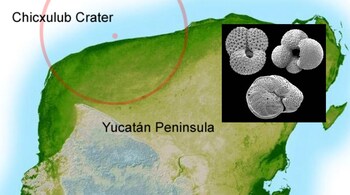


66 million years ago, Earth faced a global catastrophe, a 14-kilometer-wide asteroid struck what is now Mexico’s Yucatán Peninsula. The impact ended the age of dinosaurs and reshaped life on Earth. For decades, scientists have debated how long life took to recover. Now, a groundbreaking study reveals a much faster rebound than expected. By using space dust as a natural clock, researchers have reconstructed early evolution.
What Does This New Study Reveal?
The new research reveals that life bounced back quickly after the asteroid impact. The disaster happened around 66 million years ago. Researchers now say new species appeared within a few thousand years. In some cases, recovery began in less than 2,000 years. This shows life was more resilient than previously thought. The findings focus mainly on marine ecosystems. Tiny ocean organisms were among the first to recover.
Who Did This Study?
Chris Lowery, a micropaleontologist at the University of Texas at Austin is lead author of the study. “These microfossils allow us to reconstruct diversity really well, but they also allow us to see with precision through geologic time how these diversity changes occur," he said.
Scientists worked with ocean sediment samples from multiple locations. They collaborated with marine research laboratories. Scientists analysed deep-sea sediment cores. These samples were collected from the Atlantic and Pacific oceans.
What Happened After the Asteroid Impact?
The giant asteroid created the Chicxulub crater. It threw dust and debris high into the sky. Sunlight dimmed for months, cooling the planet and the surface ecosystems collapsed. Many species died out, especially dinosaurs and large reptiles. But life deep in the oceans endured closer to the equator. Scientists want to know how soon life bounced back. When did new species appear again? This new study has surprising answers.
Space Dust: A Natural Timekeeper
One of the most important tools in this study was space dust. Tiny particles constantly fall on Earth from outer space. These particles contain a rare isotope called helium-3. Helium-3 enters ocean sediments at a steady rate. It does not depend on climate or volcanic activity.
This makes it a reliable natural clock. By measuring helium-3 levels in sediment layers, scientists can calculate how much time has passed. Each layer acts like a timestamp from the past. With space dust, researchers could date fossil layers precisely. They pinpointed when new species first appeared.
How Foraminifera Helped in Studying This Event?
Foraminifera are tiny marine organisms. They live in oceans and build small shells. When they die, their shells sink to the seabed. Over time, these shells form fossil layers. They are preserved in ocean sediments. Scientists use them as markers of past life. After the asteroid impact, many foraminifera species vanished. But new ones appeared soon after. This made them perfect indicators of recovery.
Why This Discovery Matters?
This discovery changes how scientists view mass extinctions. It shows that recovery can happen surprisingly fast. Life does not always need millions of years to rebound.
It highlights the resilience of Earth’s ecosystems. Even after global destruction, adaptation can be rapid. Nature finds ways to survive. The findings also improve climate and evolution models. Accurate timelines help scientists understand past environments.
Discover the latest Business News, Sensex, and Nifty updates. Obtain Personal Finance insights, tax queries, and expert opinions on Moneycontrol or download the Moneycontrol App to stay updated!






