

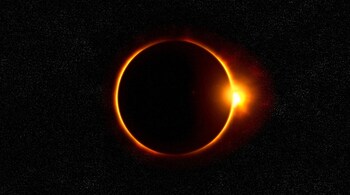


Skywatchers are tracking the first solar eclipse of 2026, an annular event on February 17, raising questions about its visibility in India and what it means for observers worldwide.
The February 17 solar eclipse will create an annular ring of fire. During this event, the Moon will cover most of the Sun. About 96% of the Sun’s centre will be obscured. The eclipse phase will last up to 2 minutes. The glowing solar rim will appear red-orange. Eclipse observers describe this sight as visually dramatic. According to a report published by Forbes, visibility will be extremely limited. The eclipse path will pass only over Antarctica. Most of the world will miss the event entirely.
Visibility of the February 2026 Solar Eclipse
The annular eclipse will not be visible from India. Astronomers confirm no phase will appear over Indian skies. The event will occur during daytime elsewhere. In Antarctica, observers may see the full annular phase. Because of this limited path, public viewing opportunities are rare. Experts say this eclipse begins an unusual sequence. Three solar eclipses will occur within 708 days. The next eclipse will arrive on February 6. That ring of fire will cross Chile and Argentina. Parts of West Africa will also witness it.
Understanding the Annular Solar Eclipse
NASA explains annular eclipses occur when the Moon appears smaller. This happens when the Moon is farther from Earth. The Moon cannot fully cover the Sun then. A bright solar ring remains visible around it. Unlike total eclipses, sunlight is never fully blocked. Scientists stress that direct viewing is dangerous. Special solar viewing glasses are always required. Damaged or scratched viewers should never be used. Children must always be supervised during eclipse observations.
Religious Context and What Comes Next
In India, the February 17 eclipse carries no ritual significance. Since it is not visible locally, Sutak rules will not apply. Religious observances linked to eclipses will not be followed. The third eclipse in this series will occur later. On January 26, 2028, a long annular eclipse will unfold. It will last over 10 minutes. Observers in the Galapagos, Ecuador and Brazil will see it. The event will end at sunset in Spain. Astronomers say patience will reward eclipse followers worldwide.
Discover the latest Business News, Sensex, and Nifty updates. Obtain Personal Finance insights, tax queries, and expert opinions on Moneycontrol or download the Moneycontrol App to stay updated!






