

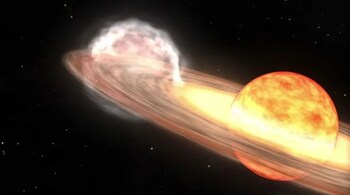
The night sky might shortly be brightened by a rare heavenly occurrence. A temporary new star can be produced through the eruption of a distant star system. The phenomenon has been highly predicted by professionals, but it is difficult to predict when and if it is going to take place. For some experts, it can possibly appear this week.
The Blaze Star: What is it?
The Blaze Star, or T Coronae Borealis (T CrB), is an erupting nova. It erupts every 80 years, briefly being visible. The system consists of a red giant and a compact white dwarf. A white dwarf strips hydrogen from a red giant over time. Pressure builds and eventually leads to a brilliant explosion. The star occasionally comes back into sight due to the activity.
When Would It Appear?
Astronomers have tracked changes in the brightness of T CrB. The nova may appear on March 27, as predicted by some scientists.
The dates given below are 10 November, 25 June 2026, and 8 February 2027 if it does not appear.
These predictions follow the star system's 228-day orbit.
A third star in the system could be hidden, one theory suggests. This star would influence the explosions if it exists. This theory remains unproven, however. Why the nova follows this pattern remains unknown to scientists.
How and Where to View It
The constellation Corona Borealis is where the Blaze Star will be visible. This little constellation is situated between Boötes and Hercules. Your position on Earth determines where it is in the sky. Sites such as TheSkyLive.com can assist in finding it.
The star will be as luminous as the North Star when it reaches a magnitude of +2. For about a week, it will be visible to the naked eye. It may be visible longer to those who possess binoculars or telescopes.
This rare phenomenon may happen at any time. For a stunning spectacle, stargazers should keep watching the night sky.
Discover the latest Business News, Sensex, and Nifty updates. Obtain Personal Finance insights, tax queries, and expert opinions on Moneycontrol or download the Moneycontrol App to stay updated!





