

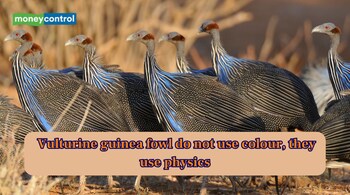


At first glance, the bird looks impossibly unreal. Its feathers glow electric blue under African sunlight. Black and white stripes ripple like carefully painted armour. This is the vulturine guinea fowl, and nothing about it is accidental. Scientists say its appearance hides a remarkable scientific secret. The colour does not come from pigment at all. Instead, the bird uses physics to paint itself.
Colour created without colour
Most animals rely on pigments for colourful feathers. This bird follows a different evolutionary rule entirely. Its blue colour forms through microscopic feather structures. These structures scatter light in precise ways. Only blue wavelengths reflect back to human eyes. Remove the light, and the colour vanishes. There is no blue dye inside the feather. The colour exists only when light cooperates.
Why evolution chose such brilliance?
Bright feathers usually signal courtship or mating displays. But this species breaks that familiar evolutionary pattern. Males and females look nearly identical. This detail changed how scientists interpreted the colour.
The feathers serve communication, not romance. They help individuals recognise flock members quickly. Open savannas offer little visual cover. Standing out becomes a survival advantage.
Feathers that speak without sound
The Vulturine guinea fowl live in large social groups. Their environment is noisy, windy, and unpredictable. Sound signals can easily disappear across open land. Visual signals never stop working. The bold patterns allow instant group coordination. A sudden movement ripples through the flock instantly. Predators struggle to isolate a single target. In numbers, visibility becomes protection.
A hidden signal of health
Creating structural colour demands biological precision. Feather nanostructures must form perfectly during growth. Poor nutrition disrupts this delicate architecture. Brighter feathers may signal stronger individuals. Duller plumage can reveal stress or weakness. The flock reads these cues silently. Survival decisions happen without confrontation.
This Bird is more than beauty
Scientists say the bird challenges how humans see colour. It proves nature engineers solutions without chemicals. Light itself becomes a biological tool. Researchers now study these feathers for inspiration. Potential applications include materials science and optics. Nature solved problems engineers still struggle to copy.
The vulturine guinea fowl is not decorative. It is functional, social and scientifically profound. A walking lesson in physics, biology and adaptation. Sometimes, evolution writes its stories in feathers.
Discover the latest Business News, Sensex, and Nifty updates. Obtain Personal Finance insights, tax queries, and expert opinions on Moneycontrol or download the Moneycontrol App to stay updated!





