

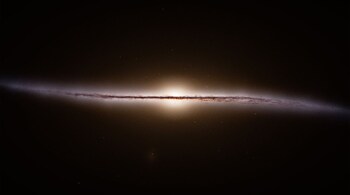
The Milky Way is not as static as it appears, according to scientists. New data from the European Space Agency's Gaia space telescope show a gargantuan wave traveling across the disc of our galaxy. This wave, which stretches tens of thousands of light-years, holds secrets to the unknown past of our galaxy.
What does the galactic ripple show?
For decades, astronomers have known that stars orbit the Milky Way’s centre and that the galactic disc is warped. Gaia’s precise measurements now reveal that the disc also wobbles, and a giant ripple stretches across its outer regions. This wave affects stars located at least 30 to 65 thousand light-years from the galaxy’s centre, nearly spanning the Milky Way’s width of about 100 thousand light-years.
Eloisa Poggio, an astronomer at the Istituto Nazionale di Astrofisica in Italy, led the team studying the phenomenon. She explained that the wave is visible not only in star positions but also in their motions. The wave pattern of vertical motions is slightly shifted compared to the stars’ positions, matching expectations for a true wave.
How do stars trace the ripple?
Scientists followed the movement with young giant stars and Cepheid stars, whose brightness changes in a predictable manner over time. These stars move with the wave, suggesting that gas in the disc might also participate in the ripple. The stars may carry a “memory” of the wave from the gas they formed from.
Researchers liken the wave to a stadium crowd performing a wave. Red areas on Gaia’s maps correspond to stars at the wave’s peak, while blue areas show stars below the warped disc. White arrows indicate vertical star movements, representing how the wave passes through the galactic disc.
What might have caused the galactic wave?
The reason behind the ripple is unclear. A past collision with a dwarf galaxy is a possible explanation, though further study is needed. The wave might also relate to the smaller Radcliffe Wave, a 9,000-light-year ripple closer to the Sun, though the connection is unclear.
Johannes Sahlmann, ESA’s Gaia Project Scientist, said the upcoming fourth Gaia data release will provide improved positions and motions for stars, including Cepheids. This will allow scientists to create even more detailed maps and deepen understanding of the Milky Way’s dynamic structure.
The find reveals our galaxy is teeming with movement, opening up patterns that stretch long beyond the Sun. Gaia's unprecedented 3D vision keeps revealing secrets of the Milky Way's past and present.
Discover the latest Business News, Sensex, and Nifty updates. Obtain Personal Finance insights, tax queries, and expert opinions on Moneycontrol or download the Moneycontrol App to stay updated!





