

When Jason Bourque first spotted the fossil, it looked small. Just half an inch wide, it sat quietly in a box. But something about it stayed with him for years. He could never quite let it go. That tiny bone, stored in the Florida Museum of Natural History, would one day reveal a story stretching millions of years back.
Fossil saved just in time
The fossil was nearly lost forever. It came from a clay mine near Florida’s border, where scientists raced to collect bones. The quarry was about to be filled in. Fossils were packed and stored away, many left untouched. Years later, while digging through the museum’s unsorted collection, Bourque came across the odd vertebra. He kept returning to it, unsure of its origin. It didn’t look like a snake or a lizard, but something about it felt important.
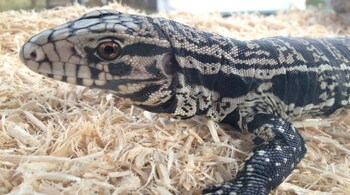
The answer came late one night. Bourque saw a tegu vertebra and paused. It looked just like the fossil he’d kept wondering about. To confirm the match, he needed more than a hunch. But traditional methods would take too long. That’s when Edward Stanley stepped in. As the museum’s digital imaging expert, he had a better idea. He used a CT scanner to build a 3D model of the fossil.
New species named after ancient forest
Stanley turned to the openVertebrate project, or oVert, for help. It had detailed 3D scans of modern tegu bones. He teamed up with Arthur Porto, the museum’s AI curator. Porto’s tool compared the ancient fossil to modern vertebrae. It found a match in the lower spine—but with some differences. The fossil came from a species never seen before.
Scientists named it Wautaugategu formidus. The name “Wautauga” comes from a nearby forest. “Formidus”, Latin for “warm”, nods to its time period. This lizard lived during the Middle Miocene Climatic Optimum. At that time, Florida’s coast reached into modern-day Georgia. Warm, swampy waters made it perfect for swimming reptiles. The tegu likely arrived from South America during this warmer spell.
But the warmth didn’t last. As temperatures dropped after the Miocene heat spike, the tegu’s habitat changed. The shoreline grew cold, and the species vanished. “We don’t see them before or after that time,” Bourque said. “It seems they were just here for that brief warm period.”
Fossil study points to future of research
Though Wautaugategu formidus is long gone, its fossil has sparked hope. Stanley believes AI will speed up fossil identification. He says many collections are full of unsorted bones. With AI tools, scientists can now compare fossils quickly and accurately. “This is just the beginning,” Stanley said. “It’s exciting to see what comes next.”
The find proves old fossils can still hold secrets. Bourque is already planning his next trip to Florida’s Panhandle. He hopes to explore more ancient coastal ridges near the Georgia border. “I’m ready to go back and look again,” he said.
What began with a forgotten vertebra has opened a new chapter. One small fossil, once lost in storage, now tells a story of climate, migration and extinction. It also shows how fresh tools and sharp eyes can breathe new life into old finds.
The study appears in the Journal of Palaeontology.
Discover the latest Business News, Sensex, and Nifty updates. Obtain Personal Finance insights, tax queries, and expert opinions on Moneycontrol or download the Moneycontrol App to stay updated!





