

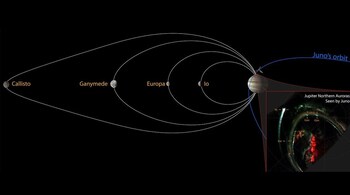
For decades, Jupiter's poles have amazed astronomers with bright auroras. Now, NASA's Juno spacecraft has unveiled a missing piece of this cosmic jigsaw, at last photographing the elusive shadow of Callisto, the planet's outer moon.
How are Jupiter's auroras different from those on Earth?
Jupiter has the most luminous auroras in our Solar System. These glowing lights occur near its poles because the planet interacts with the solar wind and its moons. In contrast to Earth's auroras, Jupiter's four largest moons can produce their own unique signatures in the atmosphere. These moon-induced lights are called satellite footprints.
Io, Europa and Ganymede had already shown their footprints through earlier observations. But Callisto, the farthest Galilean moon, remained a mystery. Hubble Telescope searches failed because Callisto’s signature is faint and usually overlaps Jupiter’s main auroral oval. That oval is the brightest region where auroras normally appear.
How did Juno finally capture Callisto’s signature?
During Juno’s 22nd orbit in September 2019, two rare conditions aligned. The auroral oval shifted closer to Jupiter’s equator, while Juno crossed the magnetic field line linking Callisto to the planet. At the same time, a strong solar stream struck Jupiter’s magnetosphere, briefly clearing the view. This allowed Juno to record Callisto’s footprint along with data on particles, waves and magnetic fields.
The finding confirms that all four Galilean moons leave auroral signatures in Jupiter’s atmosphere. Callisto’s faint footprint is sustained much like those of its siblings, completing the set of moon-induced auroras. The results, published on 1 September 2025 in Nature Communications, were led by Jonas Rabia of the Institut de Recherche en Astrophysique et Planétologie in Toulouse, France.
Discover the latest Business News, Sensex, and Nifty updates. Obtain Personal Finance insights, tax queries, and expert opinions on Moneycontrol or download the Moneycontrol App to stay updated!






