

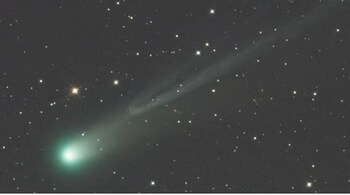
As Comet Lemmon speeds toward Earth, an astrophotographer has captured a rare cosmic sight. A huge part of the comet’s glowing tail was torn away by solar wind, creating a dazzling spectacle in the night sky.
What caused Comet Lemmon’s tail to disconnect?
Astrophotographer Brennan Gilmore recorded a striking view of the solar wind stripping a large section from Comet C/2025 A6 (Lemmon)’s tail. The comet, discovered on 3 January, is brightening quickly as it nears its closest approach to Earth on 21 October. Gilmore’s timelapse, taken on 2 October, shows the icy body’s tail being buffeted by the charged particles streaming from the Sun. The event, known as a “disconnection”, was captured using a Takahashi Epsilon 130D Newtonian telescope and a ZWO astronomy camera from Cismont, Virginia.
How does solar wind shape the comet’s tail?
The solar wind is a stream of charged particles constantly flowing from the Sun. It presses against a comet's tail, which is created from gas and dust flowing out from its icy core. This results in the tail pointing away from the Sun, rather than in the opposite direction to the comet's motion. Gilmore’s images show a glowing green coma surrounding Comet Lemmon’s nucleus, with a long luminous tail stretching across the sky as it passed near the bright star TW Leonis Minoris in the constellation Leo Minor on 4 October.
How bright is Comet Lemmon now?
According to the Comet Observation Database (COBS), managed by the Crni Vrh Observatory in Slovenia, Comet Lemmon’s current brightness is around magnitude +5.1. This means it might soon be visible to the naked eye from dark-sky locations. The comet is expected to reach its closest point to the Sun, known as perihelion, on 8 November during its 1,350-year orbit.
When and how can it be observed?
Skywatchers are advised to look out for Comet Lemmon as it continues to brighten through October. Observation guides also recommend early evening viewing for maximum visibility. Astronomers also urge people to take photos of the comet before it vanishes, capturing an unusual instant of cosmic drama as the icy visitor returns after a long wait.
Discover the latest Business News, Sensex, and Nifty updates. Obtain Personal Finance insights, tax queries, and expert opinions on Moneycontrol or download the Moneycontrol App to stay updated!





