

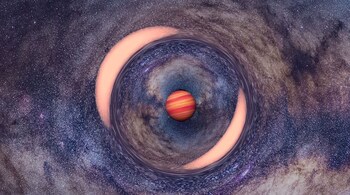

- Astronomers have, for the first time, measured the mass and distance of a rogue planet drifting alone through the Milky Way. Detected through a rare gravitational microlensing event observed from Earth and the Gaia spacecraft, the planet lies nearly 10,000 light-years away and weighs about one-fifth of Jupiter. The finding shows how combined space and ground observations can reveal elusive worlds and may guide future discoveries with upcoming telescopes.

Astronomers have measured the mass and distance of a rogue planet drifting alone through the Milky Way, marking the first time both properties have been pinned down for such an isolated world, according to research published in Science.
The planet does not orbit any star and instead travels freely through interstellar space. Scientists estimate it lies about 9,785 light years from Earth, towards the crowded centre of our galaxy. Its mass is roughly 22 percent that of Jupiter, suggesting it likely formed within a planetary system before being violently ejected.
Tracking a Rogue Planet Through Light
Rogue planets are difficult to study because they emit little light. Astronomers usually detect them through gravitational microlensing, when a planet passes in front of a distant star and briefly bends and magnifies its light. These events are rare and fleeting, often lasting only hours.
In this case, the microlensing signal was first detected on 3 May 2024. Ground based telescopes in Chile, South Africa, and Australia recorded the event independently. At the same time, the now retired Gaia space telescope also observed the same brightening six times across 16 hours.
Gaia’s position proved critical for the discovery. During the event, the spacecraft was about 1.5 million kilometres from Earth. This separation meant Gaia and Earth based telescopes saw the light distortions at slightly different times. Astronomers used this difference to calculate the planet’s distance, much like depth perception relies on two eyes.
What the Measurements Reveal
Knowing the distance allowed researchers to determine the planet’s mass with confidence. The results show the object is far smaller than a star but massive enough to resemble a gas giant. Its size indicates it likely formed around a star before being thrown out through strong gravitational interactions with other planets.
Such chaotic encounters are thought to be common in young planetary systems. This discovery supports theories that many rogue planets originate from unstable early systems rather than forming alone in deep space.
Astrophysicist Gavin Coleman of Queen Mary University of London, writing in a related perspective article, said the finding shows how coordinated observations can overcome long standing challenges in rogue planet studies.
What Comes Next for Rogue Planet Research
Future discoveries may come more quickly with new technology. The Nancy Grace Roman Space Telescope, set to launch in 2027, will scan the sky far faster than Hubble. Scientists expect it to detect many more microlensing events, increasing the chances of finding additional rogue planets.
With better data, astronomers hope to understand how common these lonely worlds are and how often planetary systems eject their own members. This single planet may represent a much larger unseen population wandering silently between the stars.
Discover the latest Business News, Sensex, and Nifty updates. Obtain Personal Finance insights, tax queries, and expert opinions on Moneycontrol or download the Moneycontrol App to stay updated!





