

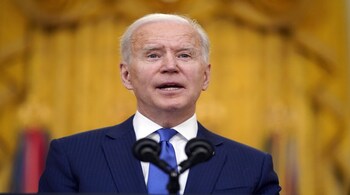
Over 40 American lawmakers on Friday wrote to US President Joe Biden, urging him to take all the necessary measures to ensure equitable administration of COVID-19 vaccines across the world.
The effort in this regard is led by two Indian-American lawmakers Congresswoman Pramila Jayapal and Congressman Raja Krishnamoorthi along with Congressman Tom Malinowski. Other signatories include Indian American Congressman Ro Khanna.
In the letter, Members of Congress called on the White House to take five specific measures - from financial investments to diplomatic efforts - to achieve the goal of a rapid and equitable vaccination programme while mitigating COVID-19 globally.
The letter is being sent ahead of the G7 Summit and at a moment in which wealthy countries have administered more than 80 per cent of global vaccines while low-income countries have received just 0.3 percent.
"We urge you to pursue additional steps to advance a bold, comprehensive strategy to vaccinate the world as quickly as possible," said the lawmakers.
"It is imperative that the United States act quickly and deploy every tool in our arsenal. Now is the time to build international cooperation and solidarity in ways we have never seen before, including using the full force of United States diplomacy, economic and commercial leadership, legal authorities, and membership in multilateral institutions. The fate of our own health and safety in the United States is inextricably connected to the wellbeing and protection of the most vulnerable among us worldwide," they wrote.
The lawmakers urged President Biden to ensure the immediate release of the 80 million doses of the vaccine which the government plans to share with the world, allocating the committed doses based on where surging numbers are greatest while also reassessing our stockpile of vaccines to release even more vaccines immediately to countries around the world.
They also urged Joe Biden to invest an additional $25 billion in the Build Back Better agenda to authorise the Biomedical Advanced Research and Development Authority (BARDA) to oversee the production of 8 billion mRNA vaccine doses; sufficient to vaccinate half the world and one of the quickest ways to increase the immediate supply of vaccines globally.
Additionally, account for and deploy towards production the remainder of the $16 million in American Rescue Plan funds allocated for COVID-19 vaccines.
Congressmen urged President Biden to use all available tools of US influence, persuasion, diplomacy and legal authorities to facilitate the rapid and widespread transfer of technology and expansion of vaccine production, including directing the National Institutes of Health to participate in the World Health Organization's (WHO's) COVID-19 Technology Access Pool programme, and negotiating and securing vaccine licencing agreements with existing manufacturers to enable broad sharing of vaccine technology and industrial processes to scale up production.
They urged Joe Biden to support a new issuance of Special Drawing Rights - a cost-free International Monetary Fund reserve asset - to help strengthen public-health budgets worldwide and provide low-income countries with resources to import medical supplies and carry out vaccination campaigns while guaranteeing support through the State Department, United States Agency for International Development, and the US membership at the WHO, UNICEF, and other agencies to help expand developing countries' technical capacities and health infrastructure to universally administer vaccines.
In the letter, the lawmakers urged the US President to convene a global vaccine summit with world leaders to spur cooperation and coordination in the development, production and distribution of vaccines; encouraging research transparency, open access, and global collaboration in engineering and manufacturing with a goal of accelerating universal vaccination.
"The world cannot wait. It is imperative that the United States act quickly and deploy every tool in our arsenal...," the Congressmen wrote in the letter.
The coronavirus has claimed over 3 million lives across the world so far, along more than 172 million confirmed infections, according to Johns Hopkins University.
Discover the latest Business News, Sensex, and Nifty updates. Obtain Personal Finance insights, tax queries, and expert opinions on Moneycontrol or download the Moneycontrol App to stay updated!





