

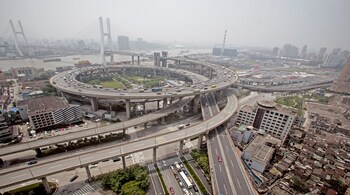
Shanghai, China's most populous city, on Tuesday again tightened the first phase of a two-stage COVID-19 lockdown, asking some residents to stay indoors unless they are getting tested as the number of daily cases rose beyond 4,400.
China's financial hub, home to 26 million people, is in its second day of a lockdown local authorities are carrying out by splitting the city roughly along the Huangpu River, dividing the historic centre from the eastern business and industrial district of Pudong to allow for staggered testing.
While the Shanghai caseload remains modest by global standards - a record 4,381 asymptomatic cases and 96 symptomatic cases for March 28 - the city has become a testing ground for the country's "zero-COVID" strategy as it tries to bring the highly infectious Omicron variant under control.
Residents east of the Huangpu were initially locked down in housing compounds on Monday, but mostly allowed to roam around within. On Tuesday, however, two residents told Reuters they were informed by their neighbourhood committees they were no longer allowed to cross their doorsteps.
"Children were still having picnics yesterday and having fun," said one of them, who declined to be named citing privacy concerns.
Wu Qianyu, an official with the municipal health commission, told a press briefing on Tuesday that locked-down residents should not leave home, even to take pets for a walk or throw out trash.
"This is in fact a key stage in nucleic acid testing and we have made a clear request for people in locked down areas to stay home," she said.
She said 17,000 testing personnel from Shanghai and surrounding regions had set up 6,300 stations and conducted a total of 8.26 million tests in the city's locked-down districts on Monday.
"The vast numbers of medical staff, grass-roots cadres, community workers and volunteers shared the very hard work on the front line of epidemic prevention and control, and should be thanked," she said.
'PAUSE BUTTON'
Drone footage published by Chinese state media showed desolate streets surrounding the skyscrapers of the city's Lujiazui financial district in Pudong. Public transport in the east has been shut, and all unapproved vehicles have been barred from roads.
The Shanghai Stock Exchange, in the western part of the city, said it has kept a skeleton staff in place within the bourse for key positions such as trading and technical system operations, while others work from home.
Residents in the west of the city continued to rush to grocery stores and vegetable markets to stock up in anticipation of the April 1 start date of their lockdown, with long queues and crowds.
But U.S. hypermarket chain Costco Wholesale Corp, whose Shanghai store has in recent days attracted long lines of shoppers, said it was closing from Tuesday, ahead of the area's scheduled lockdown, along with some gyms and shopping malls which also sit in Shanghai's western districts.
The Shanghai government rolled out new measures to try to support COVID-affected businesses on Tuesday, including rent exemptions and billions of yuan in tax rebates.
The Communist Party tabloid, the Global Times, said late on Monday that Shanghai had hit the "pause" button in what it called a "sudden change of course", but the economic damage was likely to be minimal.
It quoted Cao Heping, a Peking University economist, as saying that the city's gross domestic product growth would likely be cut by 0.5% in the first and second quarters compared with a year ago, but that the national economy would not suffer greatly.
Discover the latest Business News, Sensex, and Nifty updates. Obtain Personal Finance insights, tax queries, and expert opinions on Moneycontrol or download the Moneycontrol App to stay updated!





