

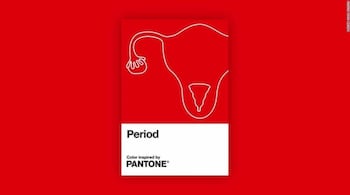
Pantone, the colour registry company, has introduced a new shade — Period red — that it hopes will get people talking about a part of life that often goes unmentioned.
By focusing on menstruation, Pantone said, it wants to overturn a taboo and draw attention to a regular life phase with a colour that is “energizing” and “dynamic.”
Period red “emboldens people who menstruate to feel proud of who they are,” said Laurie Pressman, vice president of the Pantone Color Institute. She added that the goal was “to urge everyone, regardless of gender, to feel comfortable to talk spontaneously and openly about this pure and natural bodily function.”
The announcement is partly a marketing stunt: Pantone has teamed up with the Swedish feminine products brand Intimina, and the brand’s “Seen+Heard” campaign, to help make periods just a regular part of everyday life.
But there’s no arguing that attitudes toward menstruation are outdated: The average woman has her period for 2,535 days of her life yet it continues to be a barrier to women’s equality. In some parts of the world, women still face discrimination, miss school to manage their periods and lack clean, safe products and lavatory facilities.
And periods don’t stop for pandemics. As the coronavirus crisis ravaged global supply chains, disrupted work and social lives, women and girls around the world were struggling to access basic essentials like pads and tampons.
In recent years, businesses and governments have taken steps to combat the stigma. Zomato, an Indian food-delivery firm with 4,000 workers in 24 countries, introduced a paid period leave policy in August for employees dealing with cramps and stomach pains brought on by menstruation. In 2018, Scotland became the first country to provide free sanitary products to students at schools, colleges and universities, so girls and women will no longer have to miss studies because they cannot afford sanitary products. In early 2020, the British government followed suit with a similar program.
According to Plan International UK, a girls’ rights charity, 1 in 10 girls in Britain cannot afford sanitary wear, and nearly half of girls ages 14 to 21 are embarrassed by their periods.
Menstrual equity is a political movement as well as a marketing effort. There are long-standing calls to abolish what is known as the “tampon tax,” or sales tax on sanitary products in places across the United States.
Pantone is one of the most influential organizations in colour forecasting, and in savvy marketing, experts say, with its annual colour of the year. In 2019, the pick was a “classic blue” to mirror the world’s collective anxiety and stress.
On Twitter, Period red and the statement behind it was met with praise by some and derided as virtue-signaling by others. And some raised concerns about the colour match. “I’m all for ending period taboos,” one user said, “but I don’t think painting your walls Manchester United red is really the answer.”
Zareen Ahmed, founder of the Gift Wellness Foundation, a charity based in Britain that provides sanitary pads to women in crisis, said anything that was done to normalize the conversation was positive. “This is the last taboo, the last form of discrimination that is so viscerally rooted in our patriarchal, cultural DNA that even women won’t admit to it,” she said.
Gabby Edlin, founder of Bloody Good Period, a British charity that provides products for those who can’t afford them added: “It is a PR stunt, but I think that doesn’t make it inherently bad. I think that’s a really interesting way in showing how far we’ve come.”
c.2020 The New York Times Company
Discover the latest Business News, Sensex, and Nifty updates. Obtain Personal Finance insights, tax queries, and expert opinions on Moneycontrol or download the Moneycontrol App to stay updated!





