

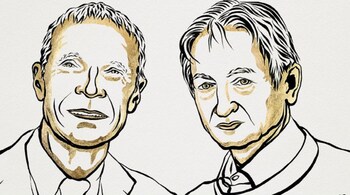
Scientists John Hopfield and Geoffrey Hinton won the 2024 Nobel Prize in Physics for discoveries and inventions that enable machine learning within artificial neural networks, the award-giving body said on Tuesday.
John Hopfield invented a network that uses a method for saving and recreating patterns. We can imagine the nodes as pixels. The Hopfield network utilises physics that describes a material’s characteristics due to its atomic spin – a property that makes each atom a tiny magnet. The network as a whole is described in a manner equivalent to the energy in the spin system found in physics, and is trained by finding values for the connections between the nodes so that the saved images have low energy. When the Hopfield network is fed a distorted or incomplete image, it methodically works through the nodes and updates their values so the network’s energy falls. The network thus works stepwise to find the saved image that is most like the imperfect one it was fed with.
Geoffrey Hinton used the Hopfield network as the foundation for a new network that uses a different method: the Boltzmann machine. This can learn to recognise characteristic elements in a given type of data. Hinton used tools from statistical physics, the science of systems built from many similar components. The machine is trained by feeding it examples that are very likely to arise when the machine is run. The Boltzmann machine can be used to classify images or create new examples of the type of pattern on which it was trained. Hinton has built upon this work, helping initiate the current explosive development of machine learning.
“The laureates’ work has already been of the greatest benefit. In physics we use artificial neural networks in a vast range of areas, such as developing new materials with specific properties,” says Ellen Moons, Chair of the Nobel Committee for Physics.
The award comes with a prize sum of 11 million Swedish crowns ($1.1 million), which is shared between the winners if there are several. The physics prize is awarded by the Royal Swedish Academy of Sciences.
Last year's physics prize was awarded to Pierre Agostini, Ferenc Krausz and Anne L'Huillier for their work in creating ultra-short pulses of light that can give a snapshot of changes within atoms, potentially improving the detection of diseases.
Physics is the second Nobel to be awarded this week, after U.S. scientists Victor Ambros and Gary Ruvkun won the medicine prize for their discovery of microRNA and its role in gene regulation, shedding light on how cells specialise.
Discover the latest Business News, Sensex, and Nifty updates. Obtain Personal Finance insights, tax queries, and expert opinions on Moneycontrol or download the Moneycontrol App to stay updated!





