
HomeNewsWorldCOVID-19 crisis | Delta variant behind spike of cases in Portugal

COVID-19 crisis | Delta variant behind spike of cases in Portugal

Portugal's National Health Institute said Sunday the highly infectious variant that was first found in India has a prevalence of 60% of new cases in the nation's capital.

June 20, 2021 / 19:46 IST
Story continues below Advertisement
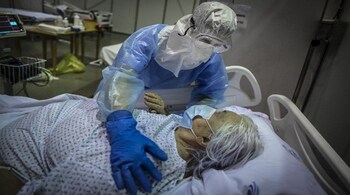
A healthcare worker attends to a patient at the Portimao Arena sports pavilion converted in a field hospital for Covid-19 patients at Portimao, in the Algarve region, on February 9, 2021. (Photo by PATRICIA DE MELO MOREIRA / AFP)

Portuguese authorities have confirmed suspicions that the new delta variant of the coronavirus is driving a spike in new cases in the Lisbon region.

Portugal's National Health Institute said Sunday the highly infectious variant that was first found in India has a prevalence of 60% of new cases in the nation's capital.

Story continues below Advertisement

Traveling this summer? Here’s what you should know about the Delta variant

The recent surge in infections caused authorities last week to ban all travel in and out of Lisbon on the weekends. The measure went into effect on Friday.

COVID-19 Vaccine
Frequently Asked Questions

View more

How does a vaccine work?

A vaccine works by mimicking a natural infection. A vaccine not only induces immune response to protect people from any future COVID-19 infection, but also helps quickly build herd immunity to put an end to the pandemic. Herd immunity occurs when a sufficient percentage of a population becomes immune to a disease, making the spread of disease from person to person unlikely. The good news is that SARS-CoV-2 virus has been fairly stable, which increases the viability of a vaccine.

How many types of vaccines are there?

There are broadly four types of vaccine — one, a vaccine based on the whole virus (this could be either inactivated, or an attenuated [weakened] virus vaccine); two, a non-replicating viral vector vaccine that uses a benign virus as vector that carries the antigen of SARS-CoV; three, nucleic-acid vaccines that have genetic material like DNA and RNA of antigens like spike protein given to a person, helping human cells decode genetic material and produce the vaccine; and four, protein subunit vaccine wherein the recombinant proteins of SARS-COV-2 along with an adjuvant (booster) is given as a vaccine.

What does it take to develop a vaccine of this kind?

Vaccine development is a long, complex process. Unlike drugs that are given to people with a diseased, vaccines are given to healthy people and also vulnerable sections such as children, pregnant women and the elderly. So rigorous tests are compulsory. History says that the fastest time it took to develop a vaccine is five years, but it usually takes double or sometimes triple that time.
View more
+ Show
PTI
first published: Jun 20, 2021 07:46 pm

Discover the latest Business News, Sensex, and Nifty updates. Obtain Personal Finance insights, tax queries, and expert opinions on Moneycontrol or download the Moneycontrol App to stay updated!



