

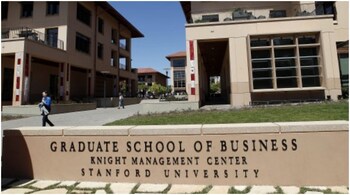
Stanford Graduate School of Business is ranked as the top US business school by Bloomberg's Businessweek 2021-22 Best B-Schools MBA ranking.
A repeat winner, with a score of 100, Stanford scored highest in compensation, networking, and entrepreneurship. Dartmouth’s Tuck School with a score of 91.8 came in second, and Harvard third, scoring 89.2.
Bloomberg Businessweek ranks 119 MBA programs around the world and the rankings are based on 19,955 surveys from students, alumni, and recruiters, as well as compensation and employment data from each school. The results are divided into four regions: Europe, Asia-Pacific, Canada, and the United States.
IMD once again topped in Europe, and CEIBS was a repeat winner in Asia-Pacific ranking. In the Asia-Pacific B-Schools ranking, the Indian School of Business has been ranked at the fifth position while IIM Bangalore secured the sixth rank. Three schools were ranked for the first time, and 102 schools in the ranking moved up or down.
For the first time, Bloomberg Businessweek's MBA ranking also included a Diversity Index that measures U.S. schools on race, ethnicity, and gender in their classes. Race and ethnicity count for 50% of the diversity score, and gender the other 50%.
"Our mission in rolling it out is to assess and rank B-Schools based on the degree to which they are addressing the institutional racism and discrimination that have excluded certain minority groups and women from U.S. MBA programs", said Bloomberg.
In the Diversity Index, North Carolina State (Jenkins) topped the list, followed by George Washington & Howard.
The survey also released data on where the recent MBA graduates, passing put from the 119 schools that participated, are working. Consulting accounted for 25 percent of all hires, the biggest share of any industry, among these graduates in their first job.
Indian School of Business accounted for 204 graduates that joined the consulting industry, just 22 graduates less than INSEAD, which holds the record of most graduates in the consulting industry.
Second to consulting is the technology industry that has 21.2 per cent of all hires and at third is the financial sector which accounts for 20.6% of all hires.
Methodology Used
The Bloomberg Businessweek surveys are designed to index four key components of a business school education: compensation, learning, networking, and entrepreneurship. This year we also the Diversity index that Bloomberg added.
Rankings also include answers to questions about campus atmosphere and quotes highlighting what students feel is best about the school. The rankings weigh each index according to the survey respondents, asking students, alumni, and recruiters which aspects of their business school experience mattered most.
The compensation index looks at pay for both recent graduates and alumni, the three-month graduate employment rate, and signing bonuses.
Learning is defined by the quality, depth, and range of instruction and asks if the curriculum applies to real-world situations, emphasizes innovation, problem-solving, and strategic thinking and if the students feel supported. It also looks at class size and collaboration.
The networking index measures the quality of those networks formed through business school by asking about the interactions between students and alumni. It considers the success rate of the career services office and recruiters’ perceptions of the school’s brand power.
The entrepreneurship index reflects how central entrepreneurship was for students and whether recruiters found graduates showed the necessary skills and drive for entrepreneurship.
Discover the latest Business News, Sensex, and Nifty updates. Obtain Personal Finance insights, tax queries, and expert opinions on Moneycontrol or download the Moneycontrol App to stay updated!





