

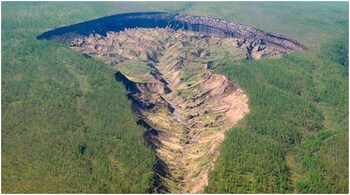
Batagaika crater in Russia's Siberia, also known as "mouth to hell" is a 282-feet-deep gaping hole in the Earth’s surface. Locals believe it is a passage to the underworld.
It was first measured in the 1980s and has since grown to be one kilometre in length and 86-metres-deep (approximately 282.1 feet). Scientists believe that the crater is the result of a melting permafrost land, which was frozen during the Quaternary Ice Age 2.58 million years ago, Daily Mirror reported.
According to the report, when the forest area was cleared in the 1960s, sunlight reached the ground and started to warm it. As the ice in the soil began to melt, the land sank. And as the frozen ground thaws, the crater grows in size.
Scientists predict that more 'mouths to hell’ may soon appear around the world due to the impact of global warming.
Satellite images of the Batagaika crater in Russia show a colossal mass of Earth sinking and appearing to pull in everything around it.
The Batagaika crater is growing by 20 to 30 metres each year year and is unstoppable. At this pace, the "mouth to hell" is set to engulf everything around it.
A study presented in 2016 by Frank Günther from the Alfred Wegener Institute in Germany revealed that the head wall of the crater has grown by an average of 10 metres (33 feet) per year over the past decade of observations, reported WION.
Discover the latest Business News, Sensex, and Nifty updates. Obtain Personal Finance insights, tax queries, and expert opinions on Moneycontrol or download the Moneycontrol App to stay updated!





