

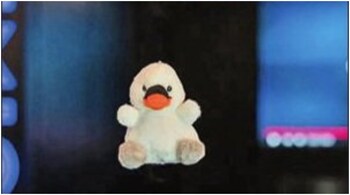
As Indian Air Force Group Captain Shubhanshu Shukla embarked on his historic spaceflight aboard Axiom Mission 4 (Ax-4), a plush white swan named Joy quietly stole the spotlight. Not merely a charming travel companion, Joy served as the mission’s Zero-G indicator—an object that signals the onset of weightlessness within the spacecraft.
The swan’s presence held cultural and spiritual resonance, particularly for India. While the selection was a joint decision by the four-member international crew, Joy’s significance for India runs deep: in Hindu mythology, the swan is the vahana (divine mount) of Goddess Saraswati, the deity of wisdom, learning, and the arts. The bird symbolises purity, transcendence, and the quiet grace of knowledge—an apt companion for a mission rooted in science, exploration, and international collaboration.
The SpaceX Dragon capsule lifted off from Launch Complex 39A at NASA’s Kennedy Space Center in Florida at 12:01 pm IST on Wednesday, after several delays pushed the original launch date from June 22. The mission marked a major milestone for Indian space ambitions, with Group Captain Shukla set to become the first Indian astronaut to reach the International Space Station (ISS).
The tradition of carrying soft toys as Zero-G indicators dates back to Yuri Gagarin’s historic flight in 1961, when a small doll floated freely to confirm the capsule had reached microgravity. Since then, astronauts have brought along dinosaurs, Earth-shaped plushies, and other figures. In the Ax-4 mission, Joy the swan performed the same role. Once the capsule entered orbit, the plush toy gently floated from its tether, indicating the official arrival into microgravity—an iconic moment watched by thousands back on Earth.
Commanding the mission is Peggy Whitson, a former NASA astronaut and now Director of Human Spaceflight at Axiom Space. Group Captain Shukla, representing the Indian Air Force and the Indian Space Research Organisation (ISRO), is the mission’s pilot. He is joined by private astronauts from Hungary and Poland.
The two-week Ax-4 mission marks a key chapter in Indo-US space collaboration, fulfilling commitments made in 2019 by then US President Donald Trump and Indian Prime Minister Narendra Modi to advance bilateral cooperation in space exploration. During their stay aboard the ISS, the astronauts will conduct joint scientific investigations, educational STEM outreach, and commercial activities.
Born in Lucknow, Uttar Pradesh, Group Captain Shubhanshu Shukla—fondly known as ‘Shux’—grew up in a modest household. His mother, Asha Shukla, is a homemaker, and his father is a retired government officer. He is the youngest of three siblings.
He completed his early education at City Montessori School, Lucknow, and secretly applied for the NDA entrance exam without informing his family. After clearing the Union Public Service Commission (UPSC) exam, he pursued a BSc in Computer Science at the National Defence Academy, followed by advanced flight training at the Indian Air Force Academy. Commissioned into the fighter stream in 2006, he built a stellar career as a test pilot, amassing over 2,000 hours of flying experience on aircraft including the Su-30 MKI, MiG-29, and Jaguar.
In 2019, he was one of four candidates selected under ISRO’s Human Spaceflight Programme for astronaut training. He underwent intensive instruction at the Yuri Gagarin Cosmonaut Training Centre in Russia and ISRO’s astronaut training facility in Bengaluru. Furthering his academic qualifications, he earned an MTech in Aerospace Engineering from the Indian Institute of Science (IISc), Bengaluru.
Ahead of the launch, Shukla penned a heartfelt note of gratitude to his wife, Kamna, on social media. The emotional post included a photograph of the couple saying goodbye through a glass partition.
“As we plan to leave the planet early morning of 25 June, I wish to thank everyone who has been involved in this mission for their support and also to all the people back home for their blessings and love,” he wrote. “Special thanks to Kamna for being the wonderful partner that you are. Without you, none of this was possible—but more importantly, none of this would matter.”
In a statement to The Times of India, Kamna, a dentist by profession, shared their long-standing bond: “We’ve studied together since Class 3. We’ve been best friends. I’ve known him as Gunjan, as Shubhanshu—the shy guy in our classroom—who’s now inspiring so many people.” The couple have a six-year-old son.
Shukla’s mother Asha Shukla also credited her daughter-in-law for her unwavering support: “It is a moment of pride for us and everyone else. Posters are being put up everywhere. Everyone is delighted that a man from this country, from this Triveni Nagar, is going to soar so high... He has all the support of our daughter-in-law. This could not have been possible without her... She has played the biggest role here.”
With this mission, Shubhanshu Shukla becomes the first Indian astronaut to travel to the ISS and the second Indian in space, following Wing Commander Rakesh Sharma’s journey aboard Soyuz T-11 in 1984.
Discover the latest Business News, Sensex, and Nifty updates. Obtain Personal Finance insights, tax queries, and expert opinions on Moneycontrol or download the Moneycontrol App to stay updated!





