

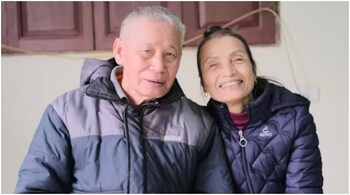
A man in China whose late wife became the country’s first person to undergo cryogenic preservation had drawn public scrutiny after forming a new relationship several years after her death, South China Morning Post reported.
According to details shared in Chinese media, 57-year-old Gui Junmin arranged for his wife, Zhan Wenlian, to be preserved shortly after she died from lung cancer in 2017. At the time, medical specialists had warned that she was unlikely to live beyond a few months. Gui, hoping that scientific advances could one day offer a way to reverse her illness, authorised a long-term preservation agreement that would keep her body stored under controlled ultra-low temperatures for three decades.
Zhan, who was 48 when she died, was accepted into a cryopreservation programme administered by the Shandong Yinfeng Life Science Research Institute, which had been set up in 2015 to explore experimental work involving human remains. The institute collaborated with Qilu Hospital at Shandong University to initiate its early trials, during which initial participants were not charged for the procedure.
Gui’s life changed again in 2020 when he suffered a severe attack of gout at home. Unable to move or reach his mobile phone, he remained on the floor for two days until relatives forced their way in to help him. Gui later reflected that the experience made him acutely aware of the difficulties of living alone and pushed him to reconsider how much support he needed in daily life.
He was later introduced to Wang Chunxia by a mutual acquaintance. Chunxia, who worked in insurance sales, had first met Gui professionally, viewing him as a potential client. Their interactions gradually shifted, and they eventually became partners. Gui said he valued her calm manner and the consistent care she offered, describing her as gentle and sincere. He also remarked that her temperament reminded him of his late wife.
Accounts shared locally stated that Chunxia took on a supportive role, ensuring he drank tea, reminding him to take medication, and helping him manage the aftermath of his health problems with patience.
Gui acknowledged that he and Chunxia came from different backgrounds and that their financial positions were not the same. He characterised his decision to be with her as “utilitarian”, explaining that he chose companionship because of his own practical needs, according to SCMP. He emphasised that the relationship did not alter his feelings for Zhan, adding that Chunxia “could never take her place”, even though he needed to continue building a life for himself.
Reactions online were sharply divided. Some social media users accused him of engaging in what they termed “emotional polygamy”, arguing that his bond with his preserved late wife remained too central to his life, according to the outlet. Others suggested that his long-standing commitment to Zhan, despite her death, appeared more like fixation than conventional devotion.
Discover the latest Business News, Sensex, and Nifty updates. Obtain Personal Finance insights, tax queries, and expert opinions on Moneycontrol or download the Moneycontrol App to stay updated!





