

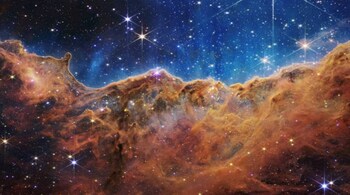
Guess who is on Insta now? That’s right, the galaxy. Outer space now has a photo album of its own. And is trending on every social media platform. There are too many close-ups to choose from, too many selfies. The universe has posed for us in all its glory in settings that can’t get more dazzling. It is walking the red carpet right now in a sparkly, glittery cape and we cannot stop clicking!
NASA’s James Webb Space Telescope just happens to magnify what Hubble Deep Fields previously only provided a tiny glimpse of – so that we can enlarge the infrared image of space infinitely. In a bit of cosmic flashback, we can even see what the milky way looked like 13 billion years ago. Thanks to the University of California, we can zoom in on the image, on every last bit of detail. The sky is at touching distance.
Of course, this is only a microcosm of the cosmos. ‘If you held a grain of sand on the tip of your finger at arm’s length, that is the part of the universe that you’re seeing. Just one little speck of the universe,’ said NASA Administrator Bill Nelson.
All the staples of our fairy tales are here: star clusters and moonbeams, luminous lights and radiant brightness, solar shadows and lunar magic. Now that we finally get a peek into all the ultimate comparisons in the world of feminine beauty, have we demystified aesthetics forever? Can we ever go back to innocent Shakespeare sonnets like Shall I compare thee to a summer’s day?
Nursery rhymes that presumed stars have nothing else to do but twinkle away 24x7 may have to auto-correct; constellations are unblinking in their shine is what it looks like. Singer Perry Como can ask us to catch a falling star and put it in our pocket, but we know now that stars are, er, a little bigger than they look. Shooting stars, meanwhile, will go unwished upon. The sun and moon may soon voice their own tales of woe, having enjoyed not just a reasonable amount of anonymity until now but also a million mystical allusions.
Romance writers will have to rewrite ‘with stars in her eyes’ when heroine looks at hero. Science fiction writers may go into a huddle. Fantasy ditties can’t have ogres descending on thunderbolts of lightning anymore. Tales of time travel, of aliens, of flying saucers and Martians are to be retold. In a nutshell, time and space have turned upside down, never to be the same again. That smoke and mirrors thing we used to do, the hocus-pocus, the abracadabra, that’s what’s leaving the building.
There are some who may say this sudden change in cosmic personality does not augur well – we liked it when the universe smiled like Mona Lisa, all mysterious. But for future generations currently in gestational mode, this photograph brings the vastness of heavens into doable telescopic nearness. Webb’s First Deep Field has brought the cosmos to our nose.
Discover the latest Business News, Sensex, and Nifty updates. Obtain Personal Finance insights, tax queries, and expert opinions on Moneycontrol or download the Moneycontrol App to stay updated!





