

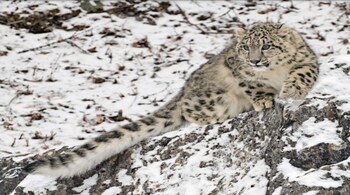
India has an estimated 718 snow leopards with Ladakh reporting the maximum number (477) of these magnificent cats, the Union Environment Ministry said on Tuesday. The Wildlife Institute of India (WII) carried out the first-ever 'Snow Leopard Population Assessment in India' (SPAI) with the support of all snow leopard range states and two conservation partners — the Nature Conservation Foundation, Mysuru, and WWF-India — between 2019 and 2023.
Environment Minister Bhupender Yadav released the report during the National Board for Wildlife meeting on Tuesday. The SPAI is the first-ever scientific exercise that reports a snow leopard population of 718 in India," the ministry said in a statement.
The exercise systematically covered over 70 per cent of the potential snow leopard range in the country, involving forest and wildlife staff, researchers, volunteers, and contributions from knowledge partners. The SPAI used a two-step framework and covered approximately 1,20,000 km2 of crucial snow leopard habitat across the trans-Himalayan region, including Union territories of Ladakh and Jammu and Kashmir, and states such as Himachal Pradesh, Uttarakhand, Sikkim, and Arunachal Pradesh.
The first step involved evaluating snow leopard spatial distribution, incorporating habitat covariates into the analysis, and aligning with the guidelines of the national population assessment of snow leopards in India by the environment ministry in 2019. This systematic approach included assessing the spatial distribution through an occupancy-based sampling approach in the potential distribution range.
In the second step, snow leopard abundance was estimated using camera traps in each identified stratified region. During the SPAI exercise, total efforts included 13,450 km of trails surveyed for recording snow leopard signs and camera traps at 1,971 locations for 180,000 trap nights.
Snow leopard occupancy was recorded in 93,392 square km, with an estimated presence in 1,00,841 square km. A total of 241 unique snow leopards were photographed. Based on data analysis, Ladakh has an estimated 477 snow leopards, Uttarakhand 124, Himachal Pradesh 51, Arunachal Pradesh 36, Sikkim 21, and Jammu and Kashmir 9.
The snow leopard range in India remained undefined until recent years due to a lack of extensive nationwide assessments for this vulnerable species. Before 2016, approximately one-third of the range (around 1,00,347 km2) received minimal research attention.
Recent status surveys have significantly increased understanding, providing preliminary information for 80 per cent of the range (about 79,745 km2), compared to 56 per cent in 2016. The report also mentions the need for establishing a dedicated Snow Leopard Cell at WII under the MoEFCC, with a primary focus on long-term population monitoring, supported by well-structured study designs and consistent field surveys.
Consistent monitoring is essential to ensuring snow leopards' long-term survival. For the same, states and UTs can consider adopting a periodic population estimation approach (every fourth year) in the snow leopard range. These regular assessments will offer valuable insights for identifying challenges, addressing threats, and formulating effective conservation strategies, the report said.
Discover the latest Business News, Sensex, and Nifty updates. Obtain Personal Finance insights, tax queries, and expert opinions on Moneycontrol or download the Moneycontrol App to stay updated!





