

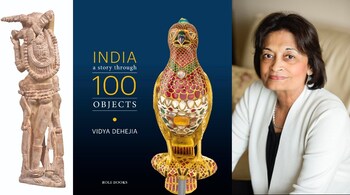
You might have your own ideas about what ought to be included in a book on objects that define India, but let that not stop you from dipping into Vidya Dehejia’s new book, India: A Story Through 100 Objects (Roli Books). From a hand axe used by our ancient ancestors and a resplendent gold falcon, which is believed to have been created for the Mughal emperor Shah Jahan, to Anant Pai’s Amar Chitra Katha, Dehejia’s book is studded with both scrumptious insights and arresting visuals that tell a story of the cross-cultural encounters that have shaped us.
In an interview with Moneycontrol, Dehejia, a professor of Indian and South Asian art history at Columbia University, New York, talks about the idea behind the book and, among others things, the objects that she left out.
How different is your book from the likes of Neil MacGregor’s 'A History of the World in 100 Objects'?
Neil MacGregor’s book was originally a radio series that became a bestselling book. The visions of multiple curatorial departments at the British Museum shaped it.
India: A Story through 100 Objects, on the other hand, is an attempt to tell a story of India that would be accessible to the lay reader and not just to scholars. And, it also had to be a compelling visual experience.
I was clear right from the beginning that it would not be an architectural history, which is why you won’t find the Taj Mahal, or the temples at Khajuraho. But, yes, it was daunting to make a choice from among the numerous objects available.
Among the things I wrestled with was how to achieve a geographical balance as well as a balance between different time periods. There have been several seminal events in recent times, but some of our richest material still comes from the past.
One of the main aims was to show that we represent a multi-cultural intermingling - of numerous cultures and peoples - and that we were never isolated but always in contact with the outside world. We were in the thick of things as far back as the first century CE. The ivory yakshi (circa 100 BCE-70 CE) in my book, which was discovered in Pompeii, is testament to that.
What were the things that you left out?
I love South Indian bronzes, but I chose to restrict their usage because their images have been overused in recent times.
I also considered using Ranjit Singh’s throne, but then felt that the honorific 19th century silver parasol created to honour and symbolically shelter the Granth Sahib spoke more about Sikhism and its values than the former.
There has always been a tendency to overemphasize the role of rulers, shahs, and emperors, but I’ve tried to include objects that were made by and used by common people.
If you take Chola bronzes, only a few were commissioned by queens and kings, while several exquisite objects were also commissioned by merchants and traders.
Tell us about some of the objects that made you look at them in a different light.
I was familiar with a majority of the objects that are included in my book. But there were still several aspects that made me go, ‘wow, I didn’t know that’.
Take the Gwalior Quran, for instance. It was created around 1399, and with its lettering mixed with floral designs and motifs, it is unlike any Quran I’ve seen elsewhere. The inspiration for such designs probably came from Hindu and Jain temples, but the most striking thing is that it was made at a time when Gwalior was ruled by the Tonwar Rajputs.
Another object that mesmerised me was the hand-axe. Now housed at the Natural History Museum, Smithsonian Institution, in Washington, it was found in Islampur, near Kalaburgi, in Karnataka, and dates back to around 500,000 BCE. I actually spent some time with an archaeologist in Chennai who helped me understand it better. One would think that it is extremely difficult to create fine sculpture, but you need a great deal of practice and skill to create a hand axe as well.
Discover the latest Business News, Sensex, and Nifty updates. Obtain Personal Finance insights, tax queries, and expert opinions on Moneycontrol or download the Moneycontrol App to stay updated!





