

Managing the natural resources of a nation is not an easy task. More often than not, the efforts to utilise them foster conflict, as in many cases searching for minerals involves cutting forests or digging hills. But what if, the search for such minerals would not be as damaging? What if there was a way to pin-point precise location of availability of resource, thereby curtailing collateral damage?
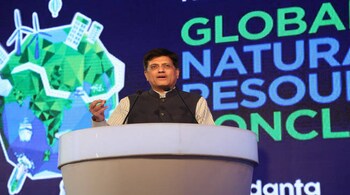
This was an interesting thought that came up for discussion during the recently held Global Natural Resources Conclave, organised by Network 18 and the Confederation of Indian Industry (CII) in New Delhi. The conclave, the first-of-its-kind in India, was aimed at providing a global platform to discuss the challenges, opportunities and potential of India's natural resources.
The issue was specifically brought forth on the second day of the event, when Piyush Goyal, Minister of State (Independent Charge) for Power, Coal, New and Renewable Energy and Mines, spoke at the event. He spoke at length on how technology could be used to bring about a sustainable solution to mine minerals. The government reportedly is aerially mapping 800,000 square kilometres of area with geological potential to scout for natural resources and transform it into a business opportunity for India’s growth story. This is the first time that the aerial mapping of this scale is being done in the country to find out the geological potential of its underground products (UGPs).
“We have determined around 800,000 square kilometres with obvious geological potential - the UGP areas. Shortly, aerial mapping will begin and over the next two-and-a-half years, we hope to complete the process. The entire 800,000 square kilometres of India’s geological potential area will be mapped aerially to get a fair idea of the locations which can be further explored,” stated Goyal.
According to the minister, converting the findings of the mapping exercise into a tangible business opportunity through the exploration of natural resources can be a part of India’s growth story. “After the mapping of a specific area, we will give out contracts for exploration in those particular locations. I would urge companies across the world to look at the contracts. One will be paid for whatever one spends on exploration, along with a potential upside. If minerals are found from the efforts to explore the piece of land, there is a significant upside being offered along with these contracts,” explained Goyal.
He further added that the ministry will put all of the exploration data in the public domain and invite entrepreneurs and companies from India and across the world to be a part of this growth story. “The natural resource wealth of this country will go on to serve the people of India, the poor who’s at the bottom of the pyramid.”
The session by Piyush Goyal was the highlight of the day. Other top speakers who shared their views on various themes included Dharmendra Pradhan, Minister of State (Independent Charge) for Petroleum & Natural Gas; Gajendra Singh Khimsar, Minister for Forest, Environment, Youth Affairs and Sports, Rajasthan; and Amitabh Kant, CEO, Niti Aayog.
Discover the latest Business News, Sensex, and Nifty updates. Obtain Personal Finance insights, tax queries, and expert opinions on Moneycontrol or download the Moneycontrol App to stay updated!





