

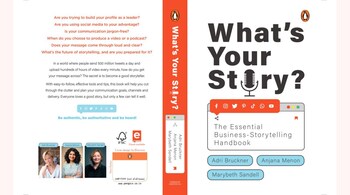
Have you been asked to work on your communication skills during an office appraisal? Are you struggling to wrap your head around the various social media platforms you are expected to be on? Do you need some guidance on how to convey your ideas without confusing or overwhelming your audience? Pick up a copy of the book What’s Your Story? written by Adri Bruckner, Anjana Menon and Marybeth Sandell, and published by Penguin Random House.
Based in Barcelona, Bruckner develops communication strategy and produces storytelling content for corporate and non-profit clients. Menon, who divides her time between Delhi and London, is a consultant to CEOs and policymakers apart from being a columnist. Sandell is based in Stockholm, and she heads group employee and leadership communications for Electrolux. All of them have worked as business journalists, teachers and mentors.
These brief biographical sketches will give you an idea of the life experiences they must have had in order to write this book. It is most likely to benefit professionals who work in the fields of public relations, corporate communications, advertising, journalism, and entertainment. However, if your job description does not revolve around storytelling, you should still consider going through the contents pages before you decide if it is not for you.
We tell stories when we write business reports, compose emails, draft tweets, make presentations, jot down minutes of meetings, make phone calls, send memes, and post images. We attend to some or all of these tasks whether we sell insurance, coffee, books, or ideas for a living. Since we spend so much time communicating, it can be useful to learn how to be more effective. This could free up precious time that is often wasted on going back and forth multiple times.
The authors write, “The world sends more than 300 billion emails each day. It reads 500 million tweets a day. There are 1.7 billion websites and 600 million blogs. Five hundred hours of video are uploaded to YouTube every minute.” If you look at these numbers, and ask yourself, “How am I going to compete with all this?” you are likely to get frustrated. It might better to empathize with your readers and listeners, and figure out what's in it for them.
Bruckner, Menon and Sandell want you to believe that storytelling can be broken down into elements, which can then be studied and practised over time. You need not feel sorry for yourself if smart headlines, powerful visuals and memorable tweets do not come ‘naturally’ to you. This book provides a toolbox of techniques you can learn, and also exercises at the end of each chapter.
Who is your target audience? This is a question that the authors want you to think about every time you decide to tell a story, whether you are addressing a press conference, creating a brochure, or delivering an elevator pitch. An awareness of your audience will make you tailor your message carefully in keeping with your goals and their needs. If you work on cultivating this awareness, your message will be relevant and it will be received well.
The authors write, “Think of a tech gadget or software you’ve been thinking about buying. When you google it to find out more, do you see stories so deep in jargon that they are useless to you? It’s important to write to the audience you want to reach.” Jargon can alienate people. For example, words like ‘ontology’ and ‘epistemology’ might be commonplace in a social science journal but they might be unsuitable for a television show.
This book mentions your audiences' “age range, location, gender, income level and interests” as some of the categories to pay attention to. You might also want to consider religion, sexual orientation, educational background, occupation, nationality, immigration status and food preferences, if these factors seem to be important while crafting the stories that you want to tell. Thinking deeply about your audience can teach you about the biases that you carry in your own mind.
Storytelling is not limited to the use of words. The book talks about how can you use data and visuals to get your message across. The authors detail some of the basics because you may need to work across various kinds of analogue and digital formats. If you are designing fire safety posters for a factory, can you think of how to make them relevant for workers who speak different languages? They are your audience, and your job is to tell a story that will keep them safe.
The authors accurately describe What’s Your Story? as “the essential business-storytelling handbook” because of the wide range of topics that it covers. It will teach you how to interview people, avoid the use of clichés, write better headlines, use infographics, provide expertise as a thought leader, build a captive audience, launch your own podcast, curate your Instagram feed, use Reddit to promote products and services, and get over your shyness.
One of the most interesting sections in the book revolves around communication in situations of crisis. The authors recommend being “honest, forthcoming, straightforward and sensitive.” These broad principles might translate differently based on whether your crisis is a pandemic, a military coup, a stock market crash, a hate crime or a security breach. They also discuss how not to communicate because you do not want to worsen the situation.
You will appreciate this book if you use it as a resource for professional development. Once you zero in on the skills that you need to hone, check out the relevant chapter and explore it slowly. The book does not demand to be read from cover to cover unless you are a professor developing a course to teach storytelling. What the authors cannot help you with is taking care of your mental health if you experience fatigue from all the communicating.
Discover the latest Business News, Sensex, and Nifty updates. Obtain Personal Finance insights, tax queries, and expert opinions on Moneycontrol or download the Moneycontrol App to stay updated!





