

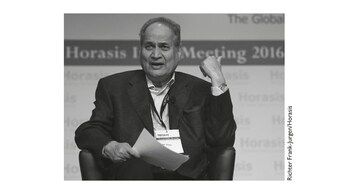
Tarun Khanna is the Jorge Paulo Lemann Professor at the Harvard Business School (HBS), and Geoffrey Jones is the Isidor Straus Professor of Business History at HBS. Their new book, Leadership to Last: How Great Leaders Leave Legacies Behind, draws on interviews conducted by Harvard faculty as part of the Creating Emerging Markets project. Further, the interviews are grouped by subjects like managing families and innovating for impact. Excerpted here is an interview with Rahul Bajaj on family managers versus professional managers.
Rahul Bajaj is the grandson of Jamnalal Bajaj, an industrialist and prominent supporter of Mohandas Karamchand Gandhi during India’s independence struggle. Rahul Bajaj took over in 1965 and is the chairperson emeritus of the Bajaj Group—one of India’s largest multinational conglomerates, which grew to include more than thirty businesses spanning consumer care, energy and sugar. In 2001, Rahul Bajaj received the Padma Bhushan. From 2006 to 2010, he was a member of the Rajya Sabha, the upper house of the Parliament. Interviewed by Srikant M. Datar in Pune on 8 July 2014.
Rahul Bajaj (RB): It is a very important subject and there is no one answer as far as I am concerned. Each case is different and has to be treated differently: what kind of family, when did you start, how many people, their temperament, their competence, their capabilities, their educational background, etc. Starting with what is family management versus professional management: what is a professional manager where he is not an owner? Then, why do you give him stock options? He becomes an owner. Well, he is a minor one, but why did you give the stock options to him? To provide an incentive, to recruit him and retain him. To provide continuity, that is what an owner does. He is born with that incentive, meaning he’s got equity, and he won’t normally leave his company for a higher salary. A professional manager, not for 20 per cent maybe, but for a 100 per cent increase in salary or for a much bigger company, may leave you. It happens every day. The owners have their wealth invested in the company. If you have the incentive of ownership—your wealth and reputation—you get the motivation, you maintain continuity. Because of your ownership, you have long-term thinking; you are not concerned with quarterly results, you’re not going to buy shares, you are not going to sell shares, and you don’t have stock options. I don’t either. None of our Bajajs in the group have ever had stock options. We have large numbers of shares, probably 50 per cent or more, in each of our companies.
So, what is a family company; what is a professional company? Take Bajaj Auto. We employ about 9,000 people top to bottom, and we have a sixteen-member board. Below the sixteen-member board, there is no Bajaj. Among the 9000 people, there is no Bajaj, there is no relative of a Bajaj. On the board, the family is represented, but who are the full-time directors? At Bajaj Auto, non-executive directors are not in management. There are only three full-time directors: the chairman, me; the vice-chairman, my cousin—not brother— Madhur Bajaj; and my elder son [Rajiv]; not even my younger son. Sanjiv [Rahul Bajaj’s younger son] is in the financial services companies and the same story repeats there; in their board level, only one full-time director is a Bajaj. I’m not . . . I am the non-executive chairman. At Bajaj Auto, I am non- executive chairman, and my elder son Rajiv is the managing director. No other relative is a full-time director or a manager in the company. Is this a family-managed company or not?
Interviewer: How do you assess the capability of family members who wish to enter management? How do you avoid bias in the selection process?
RB: If one is not qualified, is not capable, then such a professional manager will be sacked. The family guy—an example is Rajiv Bajaj, and I have said this on TV at the cost of being challenged, not once, but two or three times. I would like to know the names of three people in this country of 1.2 billion people, three people who can be better CEOs—managing directors or CEOs—of Bajaj Auto than Rajiv Bajaj. I know many managers in India. They could be as good, but my point is, who could be better than him? I don’t know of any. He has lived his life in Akurdi [in Maharashtra], he now lives in Pune, he graduated in first class with distinction in BE in mechanical engineering and got a first class with distinction in his master’s at Warwick University in the UK. You can see how he writes about marketing, brand-building as well as engineering. He happens to be a Bajaj—is he a family manager or is he a professional manager? The ideal is a family manager who is qualified. By qualified, I don’t mean only having a degree, but qualified for that post; he may have a degree or he may be like a Dhirubhai Ambani [founder of Reliance Industries] with no degree.
Problems happen in family management when there are three or four brothers. We say in India, the five fingers of a hand are not equal in size. All brothers may not be of equal capability and commitment. If somebody doesn’t want to work in the company, they should simply go. You should hold the post for which you are not just okay, but among the best. Then the fact that you happen to be an owner is an advantage. It provides you with an automatic incentive and continuity. Problems happen when the person is not very qualified and he says, ‘but I want this post—why does my brother have it, who says he is more qualified?’
Each case is different. Who is the head of the family? Do they listen to him? In my case, I happen to be the head, and they listen to me, so what I say goes, it is accepted. This puts a lot of responsibility on my shoulders. Now, if they don’t accept, that is where the family breaks. One alternative is a brother who wants a break. ‘I want to do my business my way. You say that “I’m no good”—we will find out after ten years. I want to separate; maybe I will become better than you.’ It is fine; that is a good solution. The best man should manage the business at whatever level, including at the CEO level. If they are equal in competence, according to me, the family or the owner-manager has an advantage. The problem that people are referring to is when the family members start fighting. And at that time, whoever is the leader should ensure the fighting stops and does not affect the company. That’s what I have done with the Bajaj Group. One needs a great deal of communication among family members, a lot of give and take, and maybe, sometimes, outside help.
Interviewer: If everything else is equal, then an owner-manager has the advantage for economic reasons, they get a lot of incentives, they have continuity, long-term thinking.
RB: Yes. The trouble in family management, as I said, is when members start fighting. It happened in my group. We are five brothers, including cousins. The son of one, he is very ambitious, he wanted to do business in another manner and so we decided to separate. It is a good example. The Bajaj Group didn’t suffer at all; now he is managing his companies, and we are managing our companies.
But some other groups where family members separated suffered. We had very good groups, and where are they now? They say that’s why the third and fourth generations often disappear. It’s not necessarily that the guy is not competent.
Interviewer: Before your wife’s passing in 2013, I know Rupa Bhabhi’s role with each of these brothers was critical.
RB: They respected and loved her tremendously. I don’t think they respect me like that, but they respected her always. She was on the phone frequently with my brothers and their wives; her health was bad towards the end, she couldn’t move, but she was on the phone every day with each of them. Nobody would oppose her.
Learnings from Rahul Bajaj: Not all family members are well-suited to run a business. There are major difficulties when the rules by which the family governs its involvement in the business don’t keep pace with changing aspirations.
Excerpted from Leadership to Last: How Great Leaders Leave Legacies Behind, by Geoffrey Jones and Tarun Khanna, with permission from Penguin Random House.
Discover the latest Business News, Sensex, and Nifty updates. Obtain Personal Finance insights, tax queries, and expert opinions on Moneycontrol or download the Moneycontrol App to stay updated!





