

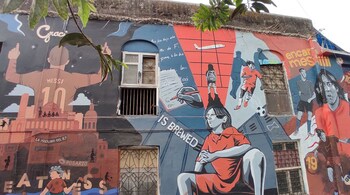
In March-April, some long-standing murals in Mumbai and Delhi - either done by or organised by Bollywood Art Project (BAP) and St+art India Foundation, respectively - disappeared overnight. They were overpainted with murals of Argentinian footballer Lionel Messi for a campaign by the India office of beer brand Budweiser. St+art called out the alcohol giant on Instagram for painting over murals by artists Okudart and Stencilcity to create "billboards" and for "hijacking the street art scene in India". Following the backlash, the brand agreed to take down the Messi art and restore the works done by St+art, an NGO that promotes street art in India, and BAP, helmed by artist Ranjit Dahiya. (As of April 30, 2021, Budweiser India communications team said that the Delhi murals had been taken down, while work was in progress to remove the Mumbai mural.)
While some dubbed St+art's challenge to Budweiser a big win for the street art community, a few did not approve of one brand "cancelling out" another brand, as evidenced from the comments on St+art's Instagram post:
"How dare they remove someone's work without permission?" one asked.
"(This street art) has been up since 2013, implies that it has served its purpose and the artist got celebrated for it. Just because Bud is a big corp does not deny them right to use this space (sic)," another argued.
Yet the incident has sparked a debate around the preservation of street art - should it be preserved? If not, then what is the brouhaha about? If yes, then what kind of street art is worthy of protection and what kind of protection?
We took these questions to a few street artists and asked if the fraternity has any legal provisions to protect their copyright and their outdoor work from erasure.
Defining the problem
Dahiya was away in Gujarat when he got news that his murals depicting Hindi film legends Madhubala and Sridevi, and the iconic film Anarkali, had been replaced with a Messi facade along the Chapel Road in Mumbai. He wasn't angry or bitter. However, he felt that the Messi mural was done rather amateurishly.
"I have no problem if somebody paints over my work," the Mumbai-based artist explained. "But when you do that, I hope it's many times more beautiful than what I had done. It should connect with the culture and emotions of the city. For instance, Mumbai is a city of Bollywood films."
Dahiya said that erasure is part and parcel of street art. If done using high-quality paints, street art may survive up to seven years or it will rub out sooner.
Anpu Varkey, whose latest wall painting in Bengaluru, featuring the feet of a woman, has become a talking point, finds little merit in debating if and how artists like her should own their street work or protect it from erasure. She explained why: "The beauty of street art lies in its impermanence, the fact it is ephemeral. One day, you have a street artwork, the next day, it's replaced with something else. Isn't it great that so many people want to paint? We should encourage this more."
Erasure comes in many forms, Varkey added. "Sometimes a building comes in front of a mural and blocks the view). The sun and the rain also fade the colours away. There is beauty in this too."
Sanjib Kumar Roy from Assam, who goes by the name of Yantr, agreed. According to him, once artists complete the artwork on a wall, private or public, their job is done. They walk away. "We have no control on how long the mural will last. But, yes, we make sure to record the original work on camera," he said.
That "control" lies with the owner or guardian of that property. If they appreciate a mural, they may fight back against those who want to vandalise it or think a few times before selling the "canvas" to advertisers or just handing it over to new artists, said Roy.
Given that the street artists aren't hung up about preserving their work, we wonder why St+art levelled the Messi murals as an act of "hijacking".
Hanif Kureshi, one of its co-founders, took our question. "We had no problem with painting over existing work. It happens all the time. Take the Bowrey Mural Wall in New York, for instance. It gets painted over every few months and people look forward to seeing new ideas... What upset us was to see a mural that has no cultural or local connect and that a similar mural was replicated in Mumbai. That's not an artwork," Kureshi said.
This reporter reached out to the communications team of Budweiser India over the phone to understand if they had informed St+Art and BAP about their Messi mural plans, if they had sought permissions from the property owners and how long they planned to keep the Messi mural on. They declined to comment on the issue citing that all their energies are currently directed towards responding to the COVID-19 crisis. But confirmed that they are in talks with the artists to restore their works.
What will the restoration involve?
Dahiya explained, “They are basically going to cover the budget for paints, scaffolding and other things that go into putting up a mural and, of course, my artist remuneration. They have no role in the creative department. I will be painting it.” Dahiya said it had cost him more than Rs 3 lakh to paint the three filmi murals, a majority of which he had spent from his pockets, and, no, he wasn’t informed by Budweiser about their Messi plans.
Whose wall, whose art?
Siddharth Nayudu, business director of Brandscope (West), an outdoor agency, unpacked why artists and brands may both be interested in some of the same walls - the so-called "terms of engagement".
"Finding a wall that's visible and relevant is very critical. Once that's done, we pay a certain amount to the property owner for a stipulated period. This is to ensure our murals don't get damaged or painted over. Consider it the insurance rent for a mural," Nayudu said.
Now while the wall space belongs to the property owner, the art is still protected under Indian copyright rules - this is where the problem gets knottier.
While the deletion of street art doesn't bother street artists and street art foundations, they are concerned about use of their work as backdrops for films, ads and photoshoots or creatives on T-shirts, laptop sleeves and postcards - without getting credit or royalty.
"I have no issues if people want to take selfies with our street art and share it but using it for commercial purposes isn't right," said Roy (Yantr). While acknowledgement or commission would be ideal, regulating an artwork that's out in public will always be a challenge, said Varkey.
"In India and as per my knowledge, we look into the legality of street art mostly when it comes up in the context of censorship," said Manojna Yeluri, an entertainment and artist lawyer and the founder of Artistik License. "While this is important, it's equally important that we acknowledge situations where street art is used commercially, without the complete and explicit permission of its creators. Because it's not just about a lack of credit, it's also a denial of a legitimate revenue stream for artists," she added.
Yeluri said artists should be more involved at the contract stage, if it's a commissioned work. "An artist may negotiate that should their work be reproduced commercially, let's say, as a merchandise, they would like to receive a percentage of the sales of the same. An artist must consult with an industry mentor or lawyer to make informed decisions," she explained.
India does offer protection to street artists under The Copyright Act, 1957 (Amendment 2012). "However, as is the case with many things in the creative industries in the country, much rests on what is considered 'standard practice' among stakeholders," Yeluri added.
While the fracas over Messi mural may not have started the conversation about copyrights, it has been critical in raising awareness about creative public interventions, Yeluri said.
Kureshi couldn't agree more, "We have done 100 goods things in the past, but only this episode has got us (the fraternity) this kind of support. It's nice to know that people care for the street art."
Discover the latest Business News, Sensex, and Nifty updates. Obtain Personal Finance insights, tax queries, and expert opinions on Moneycontrol or download the Moneycontrol App to stay updated!





