

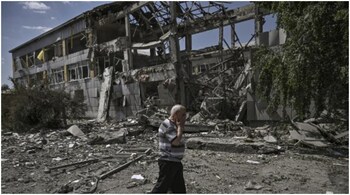
Content warning: This article contains descriptions and pictures of gun violence, tragedy and war.
The day after Nick Ut took the iconic picture of nine-year-old Phan Thi Kim Phuc running away from the Napalm explosion, was the first day of a year-long hospital stay for Kim.
June 8, 1972, around 12.30 pm, Kim was fleeing down Highway 1, away from her bombed village Trang Bang when Ut saw her through smoke and fire as he was taking pictures with his Nikon camera. As she came closer, he switched to a Leica M2 – which is now in a museum in Washington D.C. – and through its viewfinder he saw Kim crying in pain as she ran naked. He took almost a roll full of pictures and noticed her skin coming off. Ut put his camera away and took her and the other kids to a local hospital in his car. Thus began a lifelong commitment of friendship between him and Kim. And as he noted, it was so lucky that she was photographed. If not, she would have died. Because the photograph had gone ‘viral’, as much as it could in 1972, and doctors from around the world volunteered to treat her.
Photographers hope for happy endings through their pictures, something that will change a life or the world even. But ask war photographers and a different story unspools. Be it covering a live war or its aftermath, the nature of their job impacts their psyche. India’s leading photographer, Raghu Rai, who took pictures that are now synonymous with the 1984 Bhopal gas tragedy, espouses a degree of detachment. “If you want to shake the world, you shouldn’t get shaken,” he said. “Keep anger, grief and horror away from your mind’s sensor and go on with your job.”
He belongs to the line of thinking that a photographer’s job is to record the event to the best of one’s ability. “As a photographer you have to be like a television in front of the viewers and show them what’s happening on the ground.”
But there are repercussions. After more than 15 years of documenting war and strife, award-winning Kashmiri photographer Altaf Qadri believes that documenting tragedy certainly affects the mind of a photographer. “Maybe not immediately but later,” he said. “I have seen pain and agony which are universal, be it the victims of war or lynching. You can’t be mechanical about it.”
His series Children of War (Afghanistan) and Kashmir: Paradise Lost (Kashmir) document tragic loss of life and the aftermath of violence. There were many instances when he was overwhelmed by emotions but had to take pictures because he was witnessing those incidents as a journalist and it was his job to take photos. “At times it becomes extremely difficult to cope with the situation when you see disaster all around and at the same time you have to work immaculately.” He has taken medications for depression and anxiety post assignments. “I am a firm believer in God and practice my religion as much as I can and this gives me both mental and physical strength to cope up with any kind of emotion,” Qadri said.
Most war photographers are aware of the risks of their jobs but the emotions and post-traumatic stress disorder (PTSD) that they go through are lifelong and sometimes, unresolved. This is the same for those covering conflicts and natural disasters.
Yet, every so often, a picture that evokes strong emotions comes up and remains in the public consciousness.
Every photographer has a different perspective on how to take that ‘powerful’ image. Raghu Rai believes that such pictures are bigger than the photographer and over time, it is the picture that will be forever associated with the horror. “Looking at the scene with empathy will reflect in the work,” he said.
Sameer Saran, a photographer working in situations of humanitarian crisis – currently he is based in Jordan doing advocacy work in relation to the conflict in Syria – believes that photographing, in a way, itself is intervening. “Objectivity is a myth and overrated. I try to ensure that my subjectivity is as well informed as possible, and that the narrative of my photographs is guided by and engages with the ideas of right and wrong, just and unjust.”
According to Saran, the choice a photographer has to make is what could be the best intervention in a given situation. “Forget the photograph and take action to bring an immediate stop to an unfolding scenario, photo document it for broader advocacy, evidence, or something else. Because of my background in human rights and humanitarian sector, I'm a strong believer in the duty to intervene where needed.”
The ‘duty to intervene’ is, sometimes, taking a photograph that will make the world intervene. “The incredible power of still images has inspired me to stay in the profession,” Qadri said. “I and others of my ilk have risked life and limb to bear witness and report from hostile zones. We do this so that those in faraway places, like you reading this piece right now, can get a brief glimpse into what actually happens behind the headlines. We do this in the hope that we can affect change on the ground. You can look at a picture moments after it’s taken or look at it decades later, and each time you look at it, a strong picture will compel you to think, to understand, to connect.”
Such powerful images, according to Saran, make it difficult for the audience to remain bystanders and forces them to engage with the events. “I feel that's one of the main objectives of photojournalism in wars, conflicts, and humanitarian crises - to not allow people in the comfort of their homes to dissociate themselves from the consequences of the actions of their governments.”
But does the world intervene? So many powerful images have unfortunately made their appearances, like the photograph of Alan Kurdi, the Syrian refugee boy, who drowned in the Mediterranean Sea, taken by photographer Nilufer Demir.
“Sadly, these days, more often than not, I’m left bewildered and confounded,” Qadri said. “This is perhaps because, we, as journalists, go, some may argue foolishly, into locations and situations where depravity and madness pervade the air. We leave our souls open to unimaginable and unspeakably haunting sights in the everlasting and naïve hope that through our pictures and our reportage, the situation on the ground will change, something better will happen. Imagine our absolute despair when we come back and are shocked to find that most times, nothing changes.”
Can a photograph change the way the world thinks? Can it make the powers intervene? Sadly, apart from a few instances like Kim's picture, there isn't much to speak about.
Discover the latest Business News, Sensex, and Nifty updates. Obtain Personal Finance insights, tax queries, and expert opinions on Moneycontrol or download the Moneycontrol App to stay updated!





