

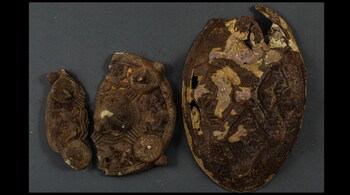
A Norwegian family embarked on a quest to find a lost earring in their own backyard, only to stumble upon an astonishing historical treasure that has unveiled a hidden chapter of the past. The initial mission was to employ a metal detector in the hopes of detecting the missing piece of jewellery. Instead, the detector's signals led them to a majestic discovery buried beneath the earth, near a towering tree behind their home. What they unearthed would astound both history enthusiasts and archaeologists alike.
These artifacts, which have since garnered the attention of experts, are believed to be remnants of a Viking burial, as reported by Live Science. Among the treasures recovered are two bronze ornaments that historians speculate were once adorned with gold. Vibeke Lia, an archaeologist affiliated with the Vestfold and Telemark County Council, offered insights to Daily Star into these remarkable findings.
One of the items, she noted, appears to be a classic oval brooch, commonly found within the resting places of Viking women. These brooches played a pivotal role in securing the shoulder straps of their halter dresses. Lia emphasized, "They come in pairs, one for each strap, so there should be another one there." The second object is also believed to be a brooch, albeit with a distinct shape.
The presence of these exquisite jewels hints at the possibility that the grave may have belonged to a woman of high Viking aristocracy. Lia observed, "They (the brooches) are in pretty good condition compared to most metal-detecting finds we get because this site has never been plowed."
The family ceased their excavation efforts upon discovering these relics, promptly sounding the alarm and summoning local government archaeologists to assess the profound discovery, as detailed in a Facebook post by the county council's cultural heritage department.
Experts are now inclined to believe that this could potentially be the first tangible evidence of Viking activity on Jomfruland, a remote island off the southeast coast of Norway, housing a mere 75 permanent residents. The discovery of these artifacts adds credence to the hypothesis that the island was indeed inhabited during the Viking Age, a period spanning from 793 to 1066 AD.
While cairns, piles of loose rocks, had previously been discovered on the island's southwest, researchers could only speculate whether they were markers left by early settlers. Before these recent findings, there was no concrete evidence of human habitation on Jomfruland prior to the Middle Ages.
The newfound treasures have left archaeologist Lia pondering the next steps. She expressed uncertainty about whether the grave would be subjected to full excavation, as it may require protection.
Discover the latest Business News, Sensex, and Nifty updates. Obtain Personal Finance insights, tax queries, and expert opinions on Moneycontrol or download the Moneycontrol App to stay updated!





