

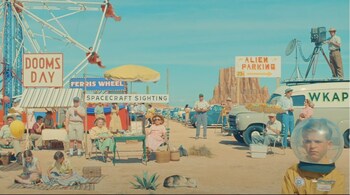
In a scene from Wes Anderson’s Asteroid City, a character, chooses to exit the play that he is part of, mid-way through the performance. “I still don’t understand the play,” he tells the creator, who is taking a nap backstage. “That doesn’t matter. You keep telling the story,” he answers. It’s an exchange that captures, or sort of stitches together the rather obscure idea at the heart of Anderson’s latest film.
For a filmmaker known for his obsessive art direction, cardboard-like filmmaking, and quirky packaging, some of which flutter with soul and wit, Asteroid City is a complicated, labyrinthine mesh trying to unfurl into a comment on existentialism and life. Oversaturated colour tones, rapid-talking people and design eccentricities that are the director’s hallmarks are in full bloom here in a film that is as stunning to look at as it hard to plunge into.
We start the film with a black and white narration (by Bryan Cranston), of a play called Asteroid City. We will witness not just the play itself, we are told, but also the circumstances of its creation. A popular American playwright, Conrad Earp (Edward Norton) types away on his machine, somewhere in '50s, as we are shoved into the fictional Asteroid City, a small town, somewhere in the Arizona desert where isolation is both an illusion and a metaphysical reality. People converge on this small, offbeat town for a peculiar youth astronomical convention. The film’s warm palette, its stagey anchorage is somewhat complemented by a wide-angle camera that spins on its axis, as if allowed one of only two motions at a time. It’s like a pop-cup comic, except it spins rather than popping. To a widely scattered ensemble cast — not all of which makes an impression — there is the protagonist Augie (Jason Schwartzman), a war photographer, secretly reeling from the loss of his wife.
After his car breaks down Augie lands in town with his son. It’s a mysterious mechanical failure, that hints at an existential creator. A man’s mind functions like a machine, for as long as it faced with the known. For the unknown, there is no fix, no toolbox, no alloy to weld fragmented parts together. “Stop helping us, we are in grief,” Augie tells his father-in-law (Tom Hanks), at one point. The setting of these conversations — an arid town, obsessed with observing the supernatural — grafts on the nose of a poignant story, the whimsy of chaos and secrecy. The kids invent oddball machines to conquer space, while an alien returns to the town to retrieve a speck of his own planet. Nuclear explosions make for an eerie backdrop (Oppenheimer-esque if you like) as cop cars hurtle across the bald pavements of a nowhere town. No matter the nature of order you might wish to construct, Anderson says, disorder propelled by jeopardy, will always remain your default state. To not know, is itself a part of knowing.
The problem with the film’s existential quest, its goofy antics and that plastered-on postcard look that resembles a school-level home economics project, is that Anderson, unlike his more direct films, wraps this one in far too many gimmicky boxes. There is a story, about the writing of a story, that must be received as a meta comment on the exaction of life itself, and yet it feels far too curved and restrictive for its own good. The rushed manner of their speaking, the unsentimental lost gaze and their curated mannerisms, though cute in an Anderson way, also draw attention away from characters who seem at times to mime each other with little in the way of distinction. It’s all light and charming, as a form of seduction, but rarely memorable as an act of expression. It’s safe to say, you’ll have to watch this more than once to make any sense of it all.
Anderson is a divisive filmmaker, someone who can end up rationing emotion and character building for the dollhouse designs he, as a matter of routine, puppeteers into reality. His films, especially since The Grand Budapest Hotel (2014), have increasingly submitted to the virtuosity of that curious, boutique taste that most of his cinema has come to stand for. It’s not for everyone, but it has manufactured for him at least, a portfolio that looks starkly, unlike anything else that will play at a theatre near you anytime soon. The problem is that when Anderson overdoes his wackiness, it becomes practically impossible to separate the exotic from the superficial. It’s a thin line, after all.
Asteroid City, in the most Andersonian of ways, is beautiful to look at. It’s practically his wardrobe meeting the retro-futuristic fantasy that he would maybe call Anderson city. With names like Tom Hanks, Scarlett Johansson, Edward Norton, Tilda Swindon and cameos from Adrian Brody and William Dafoe, and many more that would be impossible to list, it boasts of not just a cast, but a marathon list of jaw-dropping names that the director somehow fits into a collage of distractions, in search of that thread of coherence to attach themselves to. There is a great message at the centre of it all. That structure, control, is as elusive, as irresolvable as the unexpected nature of grief, the interpretation of the cosmos. Accepting chaos, is, perhaps, the only way to conceive a form of order. Or as a chorus says by the end, “You can’t wake up if you don’t fall asleep.” Unfortunately the film comes close to doing that part for you.
Discover the latest Business News, Sensex, and Nifty updates. Obtain Personal Finance insights, tax queries, and expert opinions on Moneycontrol or download the Moneycontrol App to stay updated!





