

Aakriti Handa Moneycontrol News
There are two views of history — one is the sociologist view, which says things happen because of circumstances, because of larger political, social, economic and technological forces; the second is the literature view, which says things happen because of a few good men.
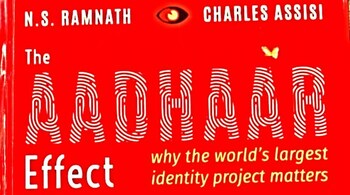
The Aadhaar Effect, written by NS Ramnath and Charles Assisi, almost personifies the Aadhaar — if it were to tell its own story from birth to a problematic adolescence and finally close to being an adult.
The birth – when the idea saw the light of the day
If one wants to know ‘how-it-all-began’, the book carries meticulous details on the building blocks of the UIDAI and the people behind the scenes who made it happen.
Elucidating on how Infosys CEO Nandan Nilekani got his hands on the project and how he got together his A-Team, who form the major characters of this story, the book treats Aadhaar as a venture.
It describes Nilekani’s vision of the UIDAI and how he got the bureaucrats and private entities to work together so as to reach to the closest approximation of that vision. Nilekani merged the scale of the government with the speed of the start-up; a government department’s stability and a start-up’s agility; the bird’s eye view of the generalist and the deep knowledge of a domain expert – all in the right concoction for his vision to turn into reality.
The book gives an account into how Nilekani picked his experts and got them on board to do something so challenging and of an unprecedented scale, giving the reader an insight into how the building blocks — the ideas, the codes, the applications — were brought together by people belonging to a wide spectrum of departments. Some of these people included Pramod Varma, K Ganga, Ashok Pal Singh, and Nachiket Mor.
The adolescence – the tumultuous time
The book correctly points out, just as diversity drives innovation, it also gives rise to conflict—in this case between the bureaucrats and the private entities.
When Nilekani got bureaucrats and techies on board, there was an ideological battle of sorts between the two groups. So much so, that the private sector complained that the UIDAI was getting “more and more bureaucratic”; yet Nilekani was sure that it was only taking its natural course.
When the UIDAI was formed in 2008, it was a subset of the Planning Commission of India, headed by Montek Singh Ahluwalia. It had no legislative backing, only executive standing which was achieved by making Nilekani a minister in Prime Minister Manmohan Singh’s cabinet.
As a result, Aadhaar faced tough competition from the Ministry of Home Affairs (which had the edge of both legal and executive backing) then headed by P Chidambaram, which maintains a similar database of citizens called the NPR.
Another turmoil – or so was Nilekani’s apprehension – that Aadhaar had to go through was its transition from the UPA government to the NDA government, and how incumbent Prime Minister Narendra Modi would perceive the project. Nilekani's doubts and fears were allayed when the NDA government passed the Aadhaar Act as a money bill.
The book gives a rather fascinating and eye-opening insight into how the UPA and the NDA perceived the Aadhaar project—both when either of them formed the government and was in the Opposition.
However, standing firm on his vision of inclusivity, Nilekani fought these battles head-on. The book zeroes in on the original idea of the Aadhaar, its automation to plug leakages and the need for biometrics, which stemmed from the problem of week passwords kept by the poor and the illiterate.
Besides, it lists the multitude of benefits that the roll-out of Aadhaar and India Stack had, including saving millions of rupees on subsidiaries, how it made tax compliance under GST easier, how it’ll help in making Ayushman Bharat see the light of the day, how it led to the formation of payments banks and even how it assisted Mukesh Ambani launch Jio.
The immature adult:
The Aadhaar Effect talks more on the cause of the UIDAI than its effect on the 1.3 billion that comprise the largest data pool.
A curious reader would want to know the boons and the banes associated with Aadhaar, however, the authors have presented the project as though it was a coin with only one side.
The book lists the criticisms of Aadhaar in 50 concise points, but lacks commentary on those criticisms; coming close to a nuanced approach but not quite there.
The proportion in which the purposefulness of Aadhaar is dealt with hardly matches its shortcomings, particularly data breaches, or how it could be (mis)used for surveillance as in the case of the Cambridge Analytica – Facebook debacle where personal information was allegedly given to a third party which analysed electorate behaviour to influence elections.
Again the matter of privacy – a nine-judge bench of the Supreme Court ruled in a landmark judgment last year that privacy is a fundamental right under Article 21 of the Indian Constitution – has been dealt with quite frivolously in the book, being referred to as “concerns of the elite”.
The book argues that the rural poor hardly understand the concept of privacy to realise its importance, especially if it is weighed on the same balance as entitlements. However, this just throws light on how the uneducated poor are taken advantage of during elections – by the lure of entitlements. And to have their data stored digitally so that it can be tracked just makes it all the easier for the government to influence the electorate.
A discerning reader would have appreciated if the scope of fraud and what preventive measures are being taken by the government was discussed in equal depth. In addition, the status of cybersecurity laws in our country could have been talked about in the light of cyber crimes associated with the Aadhaar.
The book treats Aadhaar much like a to-be victim narrating its saga to those who carry its fate in the palm of their hands, as a last attempt to let it flourish for the good of the public and mankind in general.
Discover the latest Business News, Sensex, and Nifty updates. Obtain Personal Finance insights, tax queries, and expert opinions on Moneycontrol or download the Moneycontrol App to stay updated!





