

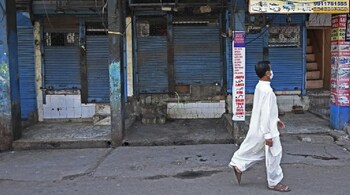
To deal with a possible third wave of coronavirus, the Delhi Disaster Management Authority (DDMA) passed a colour-coded response action plan on Friday under which curbs will be implemented in accordance to the severity of the COVID-19 situation.
At a DDMA meeting chaired by Lieutenant Governor Anil Baijal, experts stressed on having 12,000 ICU beds, sufficient oxygen, drugs and ambulances to deal with another surge in cases in the city.
Those who attended the meeting included Chief Minister Arvind Kejriwal, Deputy Chief Minister Manish Sisodia, Health Minister Satyendar Jain, Niti Aayog member V K Paul, ICMR Director General Balram Bhargava, AIIMS Director Randeep Guleria, Delhi Police Commissioner Balaji Srivastava and officials of central and state governments.
"The 'Graded Response Action Plan' was passed in the DDMA meeting today. No doubts will remain about when the lockdown will be imposed or when it will open.
Follow our LIVE blog for latest updates of the novel coronavirus pandemic
"Discussion also held about the Delta plus variant. We have to stop this variant from spreading in Delhi, for which the government is taking all necessary steps," Kejriwal tweeted in Hindi.
"After detailed deliberations and presentations made by the health department and Indian Council of Medical Research (ICMR), decision was taken to notify the Graded Response Action Plan that will objectively and transparently ensure an institutional and automatic response with regards to enforcement measures, lockdowns and unlock based on criteria such as test positivity rate and quantum of cases," an expert present at the meeting said.
Concerns arising out of new Covid variants like Delta Plus and LAMBDA were discussed at length and measures like vaccination, genome sequencing, testing, tracking and surveillance were suggested as the most effective steps to mitigate their spread, other experts said.
People travelling in large numbers to tourist destinations and violating Covid-related guidelines were also flagged as an area of concern, they said.
The colour codes based on positivity rate (on two consecutive days), cumulative number of new cases (over a week) and average oxygenated-bed occupancy (for a week) will designate four levels of alerts, officials said.
According to the draft action plan, shops and establishments of essential goods and services will be allowed to open during all the four levels of alerts.
The 'Yellow' (Level-1) alert will be sounded when the positivity rate crosses 0.5 per cent or new cases increase to 1,500 or oxygenated bed occupancy reaches 500.
The corresponding response will involve allowing construction, manufacturing activities and the opening of shops and establishments of essential goods.
However, shops and establishments of non-essential goods and services, and malls will open based on odd-even formula, from 10 AM to 8 PM. Only one weekly market per zone with 50 per cent vendors will be allowed to open, the draft plan stated.
The next level of alert coded with 'Amber' colour (L-2) will come into force if the positivity rate rises above one per cent or new cases number 3,500 or oxygenated bed occupancy reaching 700.
'Amber' alert will invoke the same responses as 'Yellow' one except that malls and shops of non-essential goods and services will be allowed to open from 10 AM to 6 PM.
The 'Orange' or L-3 alert will be the next stage which will kick-in if the positivity rate crosses two per cent or new cases number 9,000 or oxygenated bed occupancy becomes 1,000.
Construction activities will be allowed with onsite labourers while industrial activities will be restricted except those related with essential commodities and defense production. Malls and weekly markets will be closed. Only standalone non-essential shops will open from 10 AM to 6 PM, the draft plan stated.
The 'Red' alert (L-4) will be the highest level and will come into force if the positivity rate crosses five per cent or new cases rise to 16,000 or oxygenated bed occupancy reaches 3,000.
Construction activities with onsite labourers and industrial manufacturing of essential commodities, national security and defence-related productions will be allowed, while malls and weekly markets will be closed and standalone non-essential shops open, they said.
In May, the Delhi government had formed an eight-member state level expert committee to devise a strategy to mitigate and manage the possible third wave of COVID 19 in Delhi.
The city government had earlier said it has decided to increase the number of hospital beds to accommodate 37,000 cases a day in case of a possible third wave.
It has already installed 32 Pressure Swing Adsorption (PSA) oxygen generation plants with a total capacity of 29.77 metric tonnes.
Three liquid medical oxygen storage tanks with a cumulative capacity of 171 MT have also been installed.
Follow our full coverage of the coronavirus pandemic here.
Discover the latest Business News, Sensex, and Nifty updates. Obtain Personal Finance insights, tax queries, and expert opinions on Moneycontrol or download the Moneycontrol App to stay updated!





