

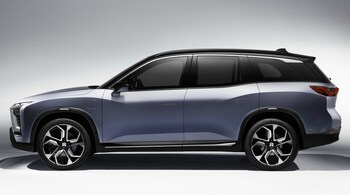
The EV revolution is no longer a speck in the horizon, it’s officially upon us. While EV occupation of India’s car market may be slower than it is in other parts of the world, rising fuel prices have forced us all to consider going electric in the near future. The good news is that EVs, though potentially more expensive to purchase right now, are much simpler machines than their fossil-fuel powered counterparts and as such are much cheaper to own. To understand the full extent of the ease of living that comes with EV ownership, it’s important to understand EVs.
The Battery
The lithium-ion battery is the most common type of battery used in electric vehicles. It emerged as a viable source of power for EVs after consumer electronic brands invested heavily in producing battery technology and till date, remains the source behind the startling speed which EVs can achieve. Lithium-ion batteries are composed of carbon, graphite, a metal oxide and lithium salt – the combination of which creates positive and negative electrodes. The battery pack spans the entire area between the four wheels, storing power which is utilised by an electric motor which can be used to power the front or rear wheels, or in certain cases, a separate electric motor can power individual wheels. The battery’s placement at the floor structure gives the car a low centre of gravity, making it more planted on the road. An EV’s range depends not only on the size of the battery, measured in kwh or kilowatt-hour, but also the overall weight, rolling resistance and aerodynamic efficiency of the design.
The “Skateboard” Chassis
Unlike internal combustion cars, EVs have a completely flat chassis, with drivetrain components housed in a vehicle’s wheels. Also known as the “skateboard chassis”, these can be built using lightweight materials (to counteract the weight of the horizontally placed battery packs), although several EV makers are returning to using steel due to its rigidity. Brands like Tesla use an aluminium chassis and body, which helps them maximise the range with a larger and therefore, heavier battery.
A skateboard chassis is simple enough to manufacture and drastically brings down the cost and complexity of EV manufacturing. They are also modular and can be shared across multiple vehicles in the brand’s portfolio. This is different from “platform sharing” that several ICE car makers refer to when utilising the same engineering design to serve as a blueprint for the production of multiple chassis. In the future, many car brands from all over the world will share battery and chassis platforms. It would also allow car owners to swap body styles with ease, essentially allowing you to modify your car to any type you want - family van, SUV, sedan etc.
The critical difference between a skateboard chassis and a unibody chassis found in ICE cars is that in a unibody or “monocoque” chassis, the body structure is the body, while in the case of a ladder-on-frame chassis (used in trucks, SUVs etc) a separate frame is used with a body attached to it. With a skateboard chassis, everything, including the electric motors are integrated.
Drivetrain
Another key advantage with EVs is the fact that the rear wheels needn’t be connected to the front via a central driveshaft running from front-to-rear. Not only does this free-up passenger and cargo space (no transmission tunnel dividing the rear half of the cabin) it enables torque vectoring entirely through software. With individual motors able to power individual wheels (or a single motor powering either the front or the rear set of wheels) traction can be maintained with far greater precision. Individual electric motors for each wheel can prove beneficial particularly in off-road scenarios where independent revolutionary speeds of each wheel can get you out of a quagmire.
Brakes
EVs possess what is known as regenerative braking, which essentially converts your car’s excess kinetic energy into electricity that recharges a portion battery on the go. While the charge is nowhere near what you would get through a dedicated charging point (A/C or D/C) it does help in extending the car’s range considerably.
It also reduces the load placed on the brakes considerably, since the electric motors also use kinetic energy dispensed during deceleration to send charge into the battery. Regenerative brakes use the electric motors to help slow the vehicle down thereby reducing brake usage, wear and tear by 50%.
How do they all interact together?
The battery sends power to electric energy to the motor, which is primarily made of a stator and a rotor, allowing it to act both as motor and alternator (In an ICE car, an alternator is used to charge the battery which is used to start the engine). The battery’s electrical energy is then supplied to the stator which uses coils inside it to create magnetic fields which in turn spins the rotor. The rotor creates the mechanical energy needed to turn the gears which in turn rotate the tyres. Electric cars do not need a multi-speed transmission and possess only one gear, which can handle high rpm and instantaneous torque supply. This is what allows the EV to be remarkably quick. When the rotor spins faster than the rotating magnetic field in the stator, (essentially when you take your foot off the accelerator) the resulting action sends power back to the battery and acts like an alternator.
In case of a hydrogen fuel cell vehicle, on-board hydrogen reacts with oxygen to create electricity on the go. The power supply is electric, just the source of the electric power has changed. Run out of hydrogen, and you run out of electricity to power the car.
Discover the latest Business News, Sensex, and Nifty updates. Obtain Personal Finance insights, tax queries, and expert opinions on Moneycontrol or download the Moneycontrol App to stay updated!





