

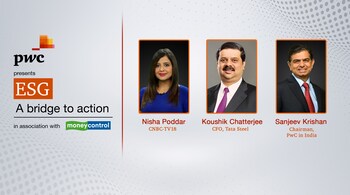
Organisations worldwide are developing and embedding environmental, social and governance (ESG) strategies to build sustainable businesses. Both global and Indian business operations have been undergoing significant changes amidst externalities such as climate change, finite resource availability, deteriorating ecosystems and evolving stakeholder expectations. The COVID-19 pandemic and associated business disruptions have only heightened and reinforced the need for action, making ESG a critical agenda for companies as they are focusing on long-term sustainable growth. To shed further light on the ESG agenda for companies, PwC, in partnership with Moneycontrol, has launched ‘ESG: A bridge to action’, a brand new platform where industry leaders, in conversation with PwC Partners, discuss the multiple aspects of ESG, explore their companies’ journey and experience with ESG, and offer advice on the road ahead for the Indian corporate sector.
Sanjeev Krishan, Chairman, PwC in India, and Koushik Chatterjee, Executive Director and CFO, Tata Steel, were invited for the inaugural episode. To lend the right note to the discussion, Ajay Piramal, Chairman of Piramal Enterprises, made some introductory remarks to share his thoughts highlighting how Piramal Enterprises plans to extend its ESG focus over the next few years and their plans for an ESG fund.
On being asked about why the ESG agenda has gained prominence in recent times, Sanjeev Krishan highlighted the role of stakeholder capitalism, the need to build trust across stakeholders and how corporations are focusing on long-term sustainable growth that addresses both ESG requirements as well as caters to the accountability demanded by stakeholders at large. A successful ESG strategy is capable of making organisations resilient, creates long-term value and builds trust.
ESG is about delivering sustained outcomes through responsible actions that address the needs of all stakeholders. Koushik Chatterjee emphasised the need for businesses to strike a healthy balance between generating profits and ensuring long term business sustainability. In this context, it is important for organisations to work with communities and use structured frameworks to guide action and measure their ESG performance and impact. The UN Sustainable Development Goals (SDGs) provides a robust framework across 17 aspects that can help organisations frame their strategic priorities and develop long-term strategies.
Commending the adoption and commitment to ESG priorities such as net zero by multiple companies and countries, Sanjeev Krishan said that corporations should also look to influence and transform their supply chains across relevant ESG dimensions. It is also important for organisations to recognise and embrace the pursuit of justice, equity, and diversity and inclusion as value enhancers. Organisations also need to explore and leverage emerging ecosystems of innovation, technology and finance and understand their role as key enablers in ESG-led value creation and transformation. He also recognised that while organisations would incur near-term costs for these transformations, the focus needs to remain on long-term value creation.
Koushik Chatterjee further highlighted the fundamental role of reporting and disclosures on ESG performance to improve transparency and accountability, to build trust with stakeholders and create an authentic identity for organisations. The risks mitigated and opportunities leveraged through an organisation’s ESG strategy can only be evaluated and understood through structured and responsive disclosure around ESG. This is becoming increasingly critical for different stakeholders, such as investors, who are looking to understand the current status and plans on ESG for companies as they expand the investment decision-making criteria going forward. While multiple frameworks currently exist to guide ESG disclosures, organisations need to expect and recognise that convergence around the multiple frameworks as well as between financial and non-financial reporting is the way forward for ESG disclosures.
Discover the latest Business News, Sensex, and Nifty updates. Obtain Personal Finance insights, tax queries, and expert opinions on Moneycontrol or download the Moneycontrol App to stay updated!





