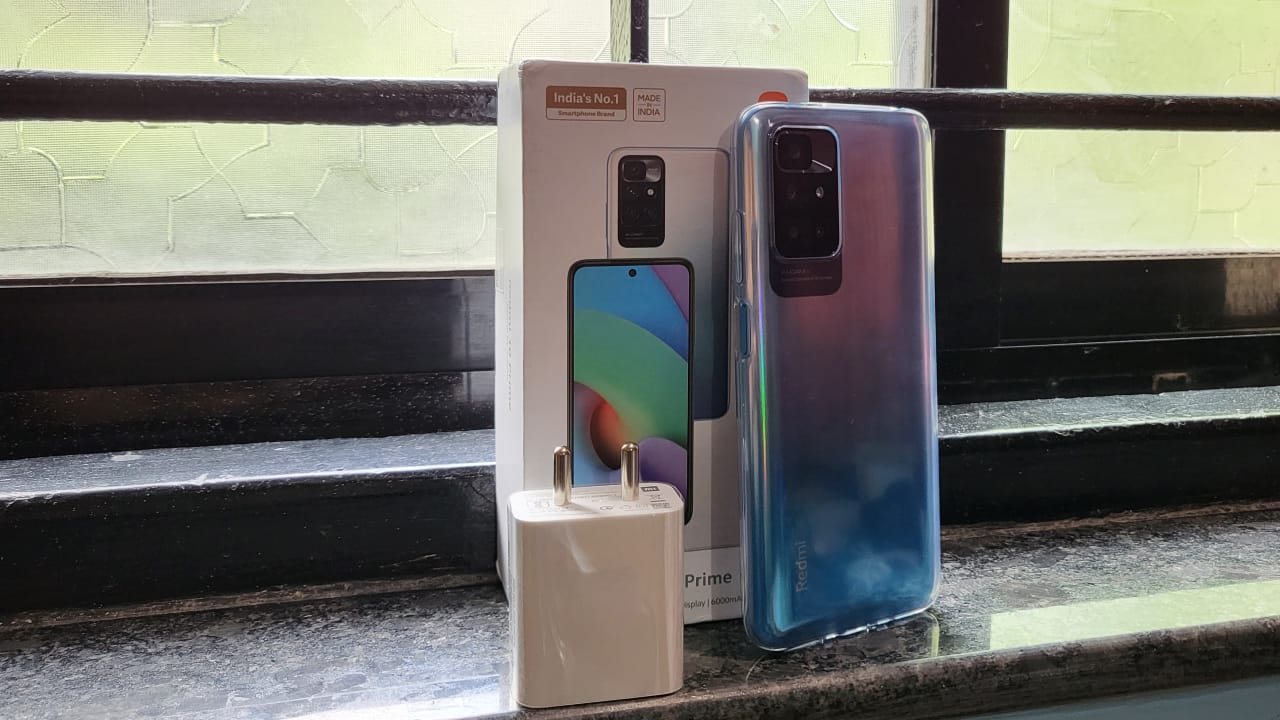
Xiaomi recently dropped the Redmi 10 Prime in India. The Redmi 10 Prime arrives as the first non-Note device under the Redmi brand in 2021 in India. It is more or less a reworked Redmi 10 with a few tweaks. At a starting price of Rs 12,499, the Redmi 10 Prime falls outside the 10K-mark, unlike most past Redmi number series phones. Our model has 6GB of RAM and 128GB of storage and will set you back Rs 14,499. For reference, the Redmi 9 Prime was unveiled for Rs 9,999 but has since been hiked to Rs 10,499. However, the Redmi 10 Prime has received quite a few upgrades over its predecessor. But do these upgrades justify the extra price? Read on to find out.
Xiaomi has definitely made quite a few adjustments to the overall design of the device. I like the fact that Xiaomi has opted for a smooth finish instead of a textured one. The phone is available in three colours – Phantom Black, Astral White, and Bifrost Blue (Our Unit). The back and frame of the device are made of plastic, which isn’t new at this price. But the glossy finish makes it a fingerprint magnet. The other noticeable difference on the Redmi 10 Prime is the new camera layout. The module is significantly bigger than that of its predecessor and is located on the side rather than the centre.
The screen has an updated hole-punch camera cutout and is protected by Gorilla Glass 3. The phone has a USB Type-C port at the bottom and a headphone jack on the top. The SIM tray is located on the left side of the device, while a volume rocker and power button/fingerprint reader sit on the right. The phone weighs around 192g and feels solid in the hand and is easy to grip thanks to the round edges and sides. The overall design of the Redmi 10 Prime feels like a refreshing change over its predecessor.
One of the big highlights of the Redmi 10 Prime is its display. Xiaomi has not only delivered a high-refresh-rate panel here, but it also boasts an FHD+ resolution. The combination is a rarity at this budget. The Redmi 10 Prime sports a 6.5-inch FHD+ IPS LCD screen with a 90Hz refresh rate and a 20:9 aspect ratio. The display gets quite bright and has a typical brightness of 400 nits, which is respectable at this price.
The Redmi 10 Prime is powered by the MediaTek Helio G88 SoC, which does offer performance similar to the MediaTek G88 SoC. The chip is paired with up to 6GB of RAM and up to 128GB of storage. I didn’t put the phone through its paces, although I did run Call of Duty: Mobile for half an hour on the device. Settings and frame rate was locked at Medium, but the game did run smoothly. I’d recommend switching to low settings to get even better frame rates. It is worth noting that we had the 6GB RAM version of the device.
For optics, the Redmi 10 Prime gets a quad-camera setup with a 50 MP Samsung SOCEL JN1 sensor at the helm. The sensor measures 1/2.76" with 0.64µm pixels and is built on the ISOCELL 2.0 technology. The sensor has an f/1.8 lens and comes with Double Super PD autofocus and real-time HDR. The other three cameras include an 8 MP ultrawide shooter with an f/2.2 aperture and a 118-degree field of view, a 2 MP macro unit, and a 2 MP depth sensor.
The main camera takes decent photos in daylight with a good amount of details, but contrast and dynamic range can be found lacking. Additionally, you do appear to see a bit of noise when shooting indoors.
For a budget smartphone, the Redmi 10 Prime’s ultrawide camera was above average with less edge softening and good detail. The macro camera can be mildly effective in daylight but often tends to miss the mark.
There’s a 50 MP mode that provides increased details while clipping into photos but HDR doesn’t work in this mode.
10/17
The Redmi 10 Prime also has a dedicated night mode, which can be quite effective so long as you have enough ambient light and stationary subjects.
11/17
On the front, the Redmi 10 Prime opts for an 8 MP selfie camera with an f/2.0 aperture, which does a good job outdoors in daylight.
12/17
The Redmi 10 Prime can capture 1080p video at 30fps on both the main and ultrawide cameras. You cannot switch between the main and ultrawide cameras while recording video, but there’s a 2x zoom mode for recording videos. On the front, video recording is also capped at 1080p (30fps).
The camera setup on the Redmi 10 Prime is nothing to write home about, but the main camera here is a big step up from the 13 MP main shooter on the Redmi 9 Prime. Even the ultrawide camera surprised me, but it was the same old sob story with the macro unit. However, it is safe to say that the main camera on the Redmi 10 Prime offers a generational leap over its predecessor.
Another key highlight of the Redmi 10 Prime is its 6,000 mAh battery, which offers enough juice to keep you going well beyond a day and a half. The battery supports 18W fast-charging but Xiaomi has included a 22.5W adapter in the box. Additionally, the USB Type-C port here also supports 9W reverse charging, which is quite useful for charging certain accessories, especially considering the battery’s size.
The Redmi 10 Prime runs on Android 10 with the latest version of MIUI (12.5) on top. The software runs smoothly, offers an abundance of settings and customizations, but doesn’t quite offer a clean aesthetic. However, for the brief period using the device, the experience wasn’t half bad, while the OS offers a ton of features and no slowdowns.
For a budget phone, the Redmi 10 Prime pretty much ticks every box there is. I’ve only used the device for a brief period, but enough to notice that there are quite a few things that this device does quite well for its price. The 50 MP quad-camera setup is solid in daylight and night, the display is the best in its class, the chipset performs well in most instances, and battery life is excellent. It is worth noting that audio is also quite solid courtesy of the dual speaker system. So despite the limited time I spent with the Redmi 10 Prime, I could safely say I was impressed by what’s on offer. That was until I heard its price; it's nearly 25 percent costlier than the previous generation.
It is worth noting that supply shortages are the main reasons for the current price hikes and I doubt Xiaomi is deliberately raising the prices of its devices. However, the 12.5K price tag puts the Redmi 10 Prime in a whole new territory as compared to previous generations. The sub-15K space is bursting with competition from Realme, Infinix, and Motorola, not to mention Xiaomi’s own Redmi Note 10 series. In conclusion, if you have a strict budget of Rs 12,499, then there’s no doubt that the Redmi 10 Prime offers the best hardware, but anything more than 12.5K and you’ll find yourself in a conundrum. In which case, you might just be better off looking elsewhere, perhaps the Realme 8 series or the Moto G series or maybe, the Redmi Note 10 series.