

Space has always been the final frontier. Don’t take my word for it, these have been immortalized by William Shatner as Captain James Kirk and Patrick Stewart as Captain Jean-Luc Picard in Gene Roddenberry’s famed Star Trek franchise. But as the famed rock band, Red Hot Chili Peppers (RHCP) reminds us in their hit song, Californication, “Space may be the final frontier, but it’s made in a Hollywood basement”, alluding to a sense of fictionality and the realistic ability of space being beyond reach for many.
The idioms in the English language have reminded us about shooting for the stars and right from days of yore, prehistoric man has stared at the moon in awe and bewilderment alike; of an object within the visibility of sight and yet with no vision of how to visit. Space exploration didn’t just have its scientific endeavours, it was a highlight, and some would say a catalyst in the Cold War between the democratic United States and the communist Soviet Union.
President John F Kennedy in his evocative oratory called for his country to send an astronaut to the moon and return him safely to Earth before the end of the decade. This was in an address to Congress on "Urgent National Needs" back in 1961 and then followed by his epochal “We Choose To Go To The Moon Speech” in 1962 at Rice University in Texas. Neil Armstrong took that “giant leap” for mankind in 1969, sadly Kennedy who was assassinated in 1963 didn’t see his dream come to fruition.
Moon and space have inherently turned little children into dreamers. But could a country that was newly independent after nearly two centuries of colonial rule, dare to dream? After all, the Space Race, a seminal part of the Cold War, was about great power competition, a battle of ideologies over ideas, and a battle for geopolitical supremacy and global hegemony.
Dared To Dream
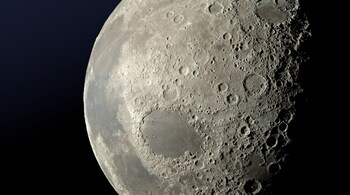
India wanted none of that. It adopted non-alignment and eschewed power blocs and like its geopolitical stances, it crafted its own space journey. From the humble beginnings of the famed photo of ISRO scientists carrying a rocket part on a bicycle to India becoming the fourth nation to successfully land a rover on the moon, but more accurately, the first nation to reach the South Pole of the moon, boldly going where no country has gone before. So, thank you, Pink Floyd, but India has got the Dark Side of the Moon covered.
It isn’t just the marvel of science, but in the words of a former President, the Audacity of Hope itself. In the post-independence era, India was a newly formed country, economically vulnerable, and said to be fissiparous as scorned and predicted by the flagrant racist, Winston Churchill.
The genesis of India’s space programme is said to have humble beginnings with Homi Bhabha and Vikram Sarabhai, in ISRO’s preceding avatar known as the Indian National Committee for Space Research (INCOSPAR). Say what you will about Prime Minister Jawaharlal Nehru’s politics, but at a time when super-poor countries aren’t meant to be superpowers, Nehru’s vision towards science and technology in setting up trailblazing institutes such as the Indian Institute of Technology (IIT) and the Indian Institute of Management (IIM) and encouragement to the space programme was indeed perspicacity, unseen in the Global South.
Space programme at a time when Maslow’s hierarchical needs of “Roti, Kapada, Makaan” often brought about scorn from international and domestic commentators. “Why spend so much money and effort to reach the moon when there is still so much poverty in India? they asked. It wasn’t profligacy but nurturing a country’s scientific temperament and setting the stage for posterity.
One Giant Step At A Time
From launching its first satellite in Aryabhatta in 1975 in collaboration with the Soviet Union to the Rohini in 1980, things were progressing, and yet, at the same time, they weren’t. Investments were paltry, as reports in 1981 state ISRO Scientists still had to carry India's First Communication APPLE Satellite on a Bullock Cart: not much of an upgrade from a bicycle.
Chandrayaan 1, launched in 2008, discovered water on the moon, its third rendition could as well find the elixir of life – water. In 2013, ISRO set out for the red planet by launching its Mars rover in Mangalyaan. There was the hubris of the West, in the famed NY Times advert which sardonically showed an Indian farmer and a cow knocking at the door of a room marked Elite Space Club where two men of Western origin, dressed in Western attire sat reading a newspaper. Apropos of the newspaper, the press had the same questions: “Why should India send a mission to Mars when millions are in poverty”? That rover landed in 2014, making India the first country to reach Mars successfully in its first attempt. Its mission to Mars was cheaper than Christopher Nolan’s Interstellar.
Chandrayaan-2 in 2019 didn’t achieve the success it was touted to. But it achieved something much more, as Prime Minister Modi consoled a disconsolate ISRO Chief, K Sivan, as the country watched on and the ISRO chief earned the plaudits.
Chandrayaan-3 is the epitome of a sporting comeback and a better comeback. India’s space programme itself is the David vs Goliath metaphor, where against all odds, from its penurious origins and then stifled infrastructure, to one, where ISRO has become a household name and is nurturing the dreams and ambitions of the country’s young demographic dividend.
The country did boldly go where few have gone before. After all, why shoot for the stars, when the moon is within reach?
Akshobh Giridharadas is a Washington DC-based former journalist. Views are personal, and do not represent the stand of this publication.
Discover the latest Business News, Sensex, and Nifty updates. Obtain Personal Finance insights, tax queries, and expert opinions on Moneycontrol or download the Moneycontrol App to stay updated!





