

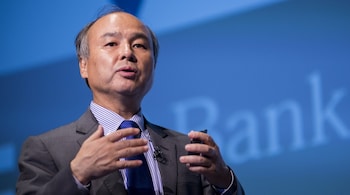
WeWork did not work, at least for Masayoshi Son. The American co-working space operator's much-hyped IPO has been called off. The share sale failed to attract retail investors even after WeWork cut down valuations to $10-12 billion, a huge discount to the $47 billion valuation it achieved when Son-led Softbank last invested in the company in January 2019.
After the share sale debacle, WeWork co-founder Adam Neumann stepped down as CEO. The entire fiasco, as CNBC’s Alex Sherman pointed out, could have been avoided. Softbank simply miscalculated by valuing the company as a high-growth tech firm instead of a real estate owner. But why did this happen? According to Sherman, "the answer is a combination of abounding optimism from Son, Softbank president Ron Fisher and Vision Fund chief Rajeev Misra (and) the elimination of dissenting viewpoints around Son".
Or, maybe Son and Softbank just got greedy. Let's look at some numbers. WeWork’s competitor IWG's market capitalisation is $4.5 billion with enterprise value at $12.16 billion. IWG’s revenue for 2018 stood at $3.07 billion and net profit at $130 million. On the other hand, WeWork reported revenue at $1.82 billion for 2018 with net loss at $1.92 billion, according to its S1 filing.
The valuation of WeWork simply does not hold water unless Softbank has valued the company based on its expansion hopes in China. In its S1 filing, WeWork mentioned China 173 times. China has always been a tough market to crack for most American companies, but WeWork has already captured around 15 percent of work space in Greater China. To add to that, it has been scaling up in India. WeWork's plans in world's two most populous countries were probably why Son believed WeWork would grow to become a $100-billion company in the next few years. But retail investors clearly did not buy this vision.
A close look at Softbank's investments in India hints at Son's love for investing at inflated valuations. Let's look at Son's top two bets in India – Oyo and Ola Electric.
In September 2018, Softbank invested in the Indian budget hotel operator Oyo for a valuation of $5 billion, and it is looking to invest again. This time, the valuation is $15 billion. Interesting fact: Oyo's valuation jumped three fold after its founder Ritesh Agarwal bought back shares. Interestingly, the share buy-back was financed by Nomura and Mizuho who consider Softbank as one of their top clients. In a piece last week, these pages had asked the question: Should Softbank be cautious?
Oyo is not a single instance. Softbank invested $250 million in Ola Electric at a valuation of $1 billion in July 2019. And, the value of the same company was just Rs 100,000 in January 2019 when Bhavish Agarwal, founder and CEO of Ola, bought 92.5 percent stake from ANI Technologies.
To add to that, none of them make money. So far, Softbank's sole success in India was Flipkart that got sold to WalMart last year for $16 billion. Almost all other Indian startups it invested, including Paytm, Paytm Mall, Delhivery, Grofers, Policybazaar, Ola Electric, Snapdeal, Oyo, Housing, Hike Messenger, Firstcry, among others, are still burning cash. InMobi, is probably the only company that has claimed to be profitable so far. And Snapdeal is a company that has come back from the brink of a shutdown multiple times to run a trimmed down version of the business.
WeWork is not the first set back for Son, and it will not be the last. Son-backed Uber's valuation has fallen from $120 billion to just $45.9 billion (enterprise value) in retail market. Not to forget that Son bet on Bitcoin also fell through. That’s not all.
To be fair, Son has skin in the game. In a report on October 16, 2012, Arstechnica estimated that Son lost as much as $70 billion of his own cash. Well, that’s almost close to Enron’s total estimated loss of $74 billion.
While it may not matter much for Son if his bets go bust, it is time startup founders wake up and stop inflating valuations. Otherwise, it may not be far when investment sources will dry up. Funds are raised for running a business and as long a company needs growth capital. Fund raising should not be a way to inflate valuation. Startups needs to focus on how to turn profitable, which unfortunately is not on agenda for most of them.
Startups, especially the ones with a consumer-facing businesses, burn cash to attract customers who easily shift to alternative platforms when the latter offer better discounts. Burning investors’ money leads to need for more funds, and every round of funding increases the valuation. Such startups can only sustain as long they manage to get investors. After a point, investors will get cautious and stop investing at high valuations if they do not see a clear exit route.
On the other hand, investors need to change their way of deciding where to invest. Rather than investing in clones of successful, or assumed-to-be-successful American startups, investors should invest in original ideas. Numbers and assumptions based on existing businesses do lie. Softbank's WeWork fiasco is one such example.
Discover the latest Business News, Sensex, and Nifty updates. Obtain Personal Finance insights, tax queries, and expert opinions on Moneycontrol or download the Moneycontrol App to stay updated!





