

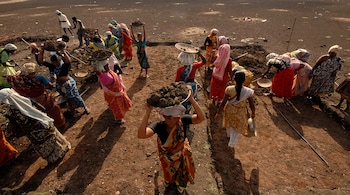
Now that both the houses of Parliament have voted to repeal Mahatma Gandhi National Rural Employment Guarantee Act (MNREGA), 2005, it is time to look at some of the policy issues which are the hallmark of Viksit Bharat—Guarantee for Rozgar and Ajeevika Mission (Gramin) Act (VB - G Ram G).
In a way, it was the ‘majboori’ of current dispensation that it took 11 years to repeal a law which was seen as a relic of success of the UPA regime.
MNREGA is now a piece of history
Very few will disagree that the implementation of repealed law was not perfect in all the states, and the need for better planning and implementation was rarely disputed.
In fact, a strong section of opinion was not convinced that it is adding any long-term value to rural infrastructure. The capital investment made in big infrastructure projects like airports, railways, ports, highways and buildings were considered by them to be better options for India’s development.
It says something about the challenge of generating rural employment and creating meaningful assets that the best minds in the government could not really come up with a seriously different legislation.
While G Ram G differs from repealed law in many respects, there are three major policy areas which I discuss below.
Allocation of funds by the Centre
The bottom-up demand-based employment programme, guaranteeing 100 days of work per household by legislation, has been replaced by an allocation-based scheme, where the Centre will decide the allocation to the States. So, the bottom-up approach of guaranteed employment on demand by workers is gone as the states will only be able to spend within the funds allocated by the Centre. Many better developed states may see lower allocations.
Centre to notify area where employment scheme will operate
The provision relating to notification of area in which G Ram G will operate is similar to the provision in repealed law. Section 3 of MGNREGA said: “Save as otherwise provided, the State Government shall, in such rural area in the State as may be notified by the Central Government, provide to every household whose adult members volunteer to do unskilled manual work not less than one hundred days of such work in a financial year in accordance with the Scheme made under this Act”.
Section 5(1) of G Ram G Act has exactly same provision (except for the number of days – one hundred and twenty-five).
During its term the UPA Government notified almost the entire country, except the urban areas, for undertaking employment guarantee where adult members were willing to do unskilled manual work.
The Centre notified the eligible areas in phases. In Phase 1 (2006) it was permitted in 200 most backward districts. In 2007, it was extended to another 130 districts. In phase 3 (2008) it was expanded to cover all remaining rural districts.
The present Union Government may not be so accommodative in its instance, and it is feared by many that its applicability may be governed by political considerations. The restrictions on West Bengal in the last three years may provide a template for refusing to approve areas which are not considered ‘desirable’ by the Central Government.
One hopes that these apprehensions will prove to be unfounded.
States required to provide much higher funding
The third area which may change the dynamics of ‘employment guarantee’ is the change in funding pattern between the Centre and the States. Under MGNREGA, the entire cost on labour component was borne by the Centre. The State governments were responsible for 25 percent of material costs and the administrative expenses. Under the new law they will have to provide 40 percent of funds (in general category states).
There was an earlier attempt to get states to share more of the burden
It is useful to explain the chronology of higher funding of schemes by the State Governments as increase in the share of States is not a new phenomenon.
In December 2014, the Centre decided to increase the share of state funding of centrally sponsored schemes to 50 percent. In February 2015, the Government accepted the recommendation of the 14th Finance Commission and devolution of funds under the central divisible pool to the states was raised from 32 percent to 42 percent.
Several important schemes at that time were receiving much higher funding from the Centre. For example, Pradhan Mantri Gram Sadak Yojana (PMGSY) was funded 100 percent by Central Government grant. The resources for this were to come from the cess on High-Speed Diesel.
In 2015, there was a pushback on asking states to bear more of the cost
The decision of NDA Government to raise State’s share across the Centrally Sponsored Schemes was opposed by the States.
So, in March 2015, a Sub-Group of Chief Ministers was set up in Niti Ayog on the rationalization of Centrally Sponsored Schemes. The Chief Minister of Madhya Pradesh was its convenor. On its recommendation, the state funding in core schemes was revised to 60:40 ratio for general category states and 10 percent for the North-Eastern & Himalayan States. For the Union Territories (UTs) it was kept at 100 percent central funding.
In some schemes, the Central funding is already less than 60 percent. For example, in the Pradhan Mantri Fasal Bima Yojana (PMFBY), the Centre provides only 50 percent of subsidy on insurance premium. Several States opted out of PMFBY due to various reasons including the burden of higher subsidy.
It is feared that the condition of 40 percent funding of G Ram G may result in dissuading the poorer states from G Ram G in right earnest.
It must be noted that some schemes will continue to be entirely funded by the Centre. For example, PM- Kisan for which the BE for 2025-26 is Rs 68,000 crore.
No employment for 60 days to cover peak agricultural season
The fourth important provision in the laws is that the States will have to announce in advance a period of up to 60 days of peak agricultural season during which works under the scheme will not be undertaken. This is supposed to ease availability of labour during sowing and harvesting.
There is a general perception that the cost of cultivation of crops has gone up due to non-availability of labour in several parts of India. This has resulted in mechanisation of harvesting of sugarcane in Karnataka and Maharashtra. In Punjab and Haryana, the farmers complain that labour is not easily available. This may be true for some states even though conclusive evidence is lacking.
The wages in MGNREGA were generally lower than market rates. So, why would a labourer not choose to work for higher wage during peak agricultural season?
The rate of growth of nominal rural wages has just about kept pace with consumer price inflation. Lower expenditure on wages may reduce cost of cultivation.
Conclusion
MGNREGA was a path breaking piece of legislation. It had many operational deficiencies, but the template was visionary as proved during Covid-19 pandemic period. One can only hope that VB – G Ram G will not be starved of funds, and it will not be used for political ends to discriminate against the opposition-ruled States.
In any case, the vision of guaranteed rural employment, on demand, may not survive for long.
(Siraj Hussain is a former Union Agriculture Secretary.)
Views are personal, and do not represent the stance of this publication.
Discover the latest Business News, Sensex, and Nifty updates. Obtain Personal Finance insights, tax queries, and expert opinions on Moneycontrol or download the Moneycontrol App to stay updated!





