

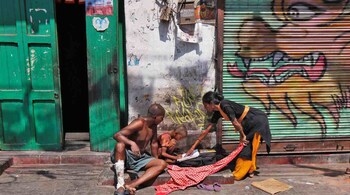
Not very long ago, policymakers working on poverty eradication programmes had enough cause for cheer. Fewer people now live on less than $1.90 per person per day around the world — 10 percent of the world’s population or 734 million people, which is nearly 36 percent or 1.9 billion people less than in 1990. However, the ongoing COVID-19 crisis, coupled with the crash in oil prices globally, is threatening to reverse the gains made in poverty eradication in the last five years.
In India, this is estimated to take alarming proportions, casting a disproportionate impact on the poor. This will manifest itself in job losses, loss of remittances, rising food prices, and disruptions in services such as education and healthcare. Globally, for the first time since 1998, poverty rates are predicted to go up as economies head into recession and GDP per capita drops. The World Bank estimates that 40 million to 60 million people will fall into extreme poverty (under $1.90/day) in 2020 as a result of COVID-19.
In India, the devastating effects of the pandemic have already been visible in recent months: In April, UN’s International Labour Organization estimated 400 million workers from India’s informal sector to be pushed deeper into poverty due to COVID-19. Multiple reports also predict an increase in poverty with India adding about 354 million more poor people. A World Bank study estimated that 70-100 million ‘new poor’ — people who were either not poor or who had escaped poverty — would be added to this pool.
COVID-19 has laid bare the fragility of India’s poor like never before, compounded by rising unemployment and slowdown in the economy. Further, these are pushing people into crime and also changing the nature of crimes the world over. The number of street crimes in India has spiked ever since authorities began relaxing the Coronavirus measures in June. Alongside, instances of profiteering, black-marketing, and hoarding of essential goods, illicit drug cartels, domestic violence and cyber frauds have increased manifold.
Somewhere between this emerging scenario of deepening poverty and spiralling rate of crime, there may be valuable insights in behavioural science for policymakers working on poverty eradication programmes and the criminal justice system. Multiple studies now reveal that rising levels of poverty harm the cognitive abilities of the poor, and put them at a disadvantage, leading them to often make bad decisions in financial distress. This could potentially promote counterproductive risk behaviours among the poor such as excessive borrowing or criminal acts which could further escalate poverty.
In Chicago Booth Professor Anuj K Shah’s work with the Mayor’s Office of Criminal Justice in New York, Shah observed the people who fail to appear in court for low-level offenses and found that poverty fatigued the poor, which put them at the risk of getting caught up in the criminal-justice system because of a mistake occurring from being mentally overwhelmed. While the criminal-justice system treats a missed court date as an intentional failure to show up, the research found that in some cases people could just forget. The challenges were mitigated by redesigning the summons and dispatch of text messages to make it easier for people to remember. These interventions were more effective for residents living in poorer neighbourhoods, the research noted.
The experiment yielded two valuable insights: first, poverty could tax mental bandwidth in more ways than one; and second, recognising the fine line between people who make mistakes and people who are intentionally trying to break the law can help frame policies that strengthen the criminal justice system without overburdening it with offenders booked for minuscule, unintentional offences. This is especially important in the emerging scenario where COVID-19 has led to a disruption in courts proceedings resulting in delayed trials, which has left the prisons more crowded than necessary. Nearly 805 people across jails in India had tested positive for COVID-19 by the end of June, facilitating its spread in alarming numbers. The socioeconomic disruption in the wake of the pandemic not only raises fresh policy challenges but also necessitates that prosecutors look at poverty-driven crimes with greater empathy.
Some of the emerging research into behavioural science may also hold clues for effective poverty eradication policies. In a 2015 paper, Shah, along with Harvard’s Sendhil Mullainathan and Princeton’s Eldar Shafir, designed experiments that stripped away money and put other resources in demand, shifting what people paid attention to and how they made decisions. They found that the poor think of money even in situations where many other people do not and can see clearly where most people may not, which could help them make better financial decisions. In India, for example, where sugarcane farmers are paid annually after the harvest, farmers’ attention scores were the equivalent of 10 IQ points higher than just before the harvest, when farmers were relatively poor.
In both the scenarios where people in poverty either make smart or bad decisions depending on the changing contexts, how could they be helped? In the COVID-19 world, understanding and acknowledging these psychological effects of poverty and using them to inform and bring in a rethink of the existing policies can be a big step forward.
(Pallavi Singh is a business historian in training. Views are personal.)
Discover the latest Business News, Sensex, and Nifty updates. Obtain Personal Finance insights, tax queries, and expert opinions on Moneycontrol or download the Moneycontrol App to stay updated!





