

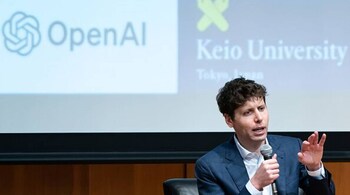
When the news hit late Friday afternoon that OpenAI had forced out
founder and Chief Executive Officer Sam Altman, almost immediately the comparisons to Apple Inc ousting Steve Jobs were making the rounds. In other words, this was a catastrophic miscalculation to unseat a tech visionary. Although history may come to see it that way as well, the passing of time might also offer another, maybe more important reflection.
As attempted coups go, what happened at OpenAI was a colossal failure. As I write this, the latest twist is that Altman and his OpenAI co-founder Greg Brockman have been hired by Microsoft Corp to lead a newly-created in-house artificial intelligence division. More than 500 OpenAI employees are threatening to jump ship and join them. Microsoft Chairman and CEO Satya Nadella must think he is dreaming: Over the course of one whiplashy weekend, he went from watching the company’s $10 billion investment in OpenAI become jeopardised to managing to make the software giant’s position in AI look even stronger. Investors agree, sending the Redmond, Washington-based company’s shares to a record high.
We still only know precious few details around the decision by OpenAI’s board to jettison Altman. Reports point to a brewing discontent over Altman’s outside interests — namely his courting of funds for a new AI hardware venture — and a divergence of opinion on AI safety. Altman, who has become the poster-man for promoting the idea of sensible regulation, is said to be on the side of moving faster to commercialise AI. The more cautious board may have thought, perhaps naively, that the checks and balances built into OpenAI’s unique governance structure — a nonprofit board overseeing a for profit entity — would give them the ability to temper Altman’s instincts. They were wrong, and at least one of them, chief scientist and cofounder Ilya Sutskever, now says he regrets sending the company into disarray.
Whether board members were justified in seeking to remove Altman isn’t the real issue. What’s truly important is that the board made a decision that was almost instantaneously overturned by the sheer power and popularity of a trailblazing cofounder. In that sense, OpenAI was no different to the tech giants that came before it: Mark Zuckerberg’s dictatorial hold on Meta Inc., or Larry Page’s and Sergey Brin’s unparalleled voting power at Google-parent Alphabet Inc. Over the past year, many felt reassured (if perplexed) by the fact that Altman, unlike those founders before him, did not hold any stock in OpenAI. The stated reason was to remove any sense that greed was the motivating factor behind the pursuit of profits, while subjecting Altman to what had been considered a higher-than-normal level of accountability. Turns out that none of it mattered: Despite warning
after warning after warning, this weekend’s events prove the cult of the founder is alive and well in Silicon Valley.
I’ve met Altman and concur with those who put him in the “one of the good ones” bucket of prominent figures in the tech industry. He’s a nerd but not in the awkward sense — a trait that made him an ideal ambassador for AI as he has humbly bounced from corridor to corridor of power in countries around the world. But this weekend we saw perhaps saw another side to the 38-year-old, a flicker of arrogance that gave a glimpse as to the dynamic with OpenAI’s board of directors. Visiting the company’s offices on Sunday, Altman took a moment to share a picture on social media of him holding a “guest” pass. “First and last time I ever wear one of these,” he wrote. This, along with reports of regular “deadlines” for the board to meet his demands, suggested a man who very much felt he was OpenAI, rather than a person who worked for it.
By Monday morning, Microsoft and Nadella had snatched victory from the jaws of defeat. Altman and Brockman — who had been forced off the board and later resigned — would immediately become Microsoft employees in charge of the company’s new in-house AI team. If OpenAI employees follow them out the door, as hundreds seem eager to do, Microsoft will have pulled off, or some might say lucked into, the most stunning acqui-hire in Silicon Valley history. As tech analyst Ben Thompson put it, “Microsoft just acquired OpenAI for $0 and zero risk of an antitrust lawsuit.”
Microsoft’s new position of strength in AI will be used to bend the new frontiers of this technology even more to its will than it has done already. Nadella’s personal involvement was instrumental in getting Altman back into the building at OpenAI, if not quite back into the company, in an intervention that was only natural given what’s at stake for the $2.8 trillion computing giant and its blockbuster $10 billion OpenAI investment, the cornerstone of its future. One inherent weakness of all major AI companies is that right now the costs of computing power, and access to the latest chips to run the technology, requires a level of financial backing that is incompatible with any true independence.
There will likely be ripple effects as other big tech companies take a closer look at their exposure AI partners, and likely demand more oversight or control. One silver lining, I guess, is that the charade of accountability at OpenAI has been exposed before the groundbreaking company found itself facing a real crisis. We can be thankful the only existential risk at the moment is the one all this has posed to OpenAI itself, not the rest of us.
Meanwhile, Nadella’s immediate concern won’t be how to restore ethical checks and balances to the development of AI, but how quickly everyone can get back to work developing AI. And so, “the mission continues,” as Altman tweeted Monday morning. But whose mission? Microsoft’s or OpenAI’s? As a Microsoft employee, Altman will find it harder to convince the world and regulators that he is working for the good of humanity, and not for the good of shareholders. He is now just another Big Tech executive. But let’s face it, he always was.
Dave Lee is Bloomberg Opinion's US technology columnist. Views are personal and do not represent the stand of this publication.
Credit: Bloomberg
Discover the latest Business News, Sensex, and Nifty updates. Obtain Personal Finance insights, tax queries, and expert opinions on Moneycontrol or download the Moneycontrol App to stay updated!





